Streaming & Channels
Stream<A, E, R> is a pull-based source: the consumer requests the next chunk, the stream computes it (possibly failing with E, needing services R), emits the chunk, and waits. This pull loop provides automatic back-pressure. Sink<A, In, L, E, R> folds chunks into a final answer. Channel is the bidirectional primitive both are built from. In practice: live in Stream 95% of the time; reach for Channel only when authoring a new operator.
Official examples: Effect's release-matched
ai-docsStream examples cover creation, transformation, consumption, and NDJSON encoding.Official guides: Introduction to Streams, Sink introduction; section-specific guides are linked where they apply. These track Effect's
mainbranch rather than this edition's audited release, so where they differ, this page and the tagged source win.
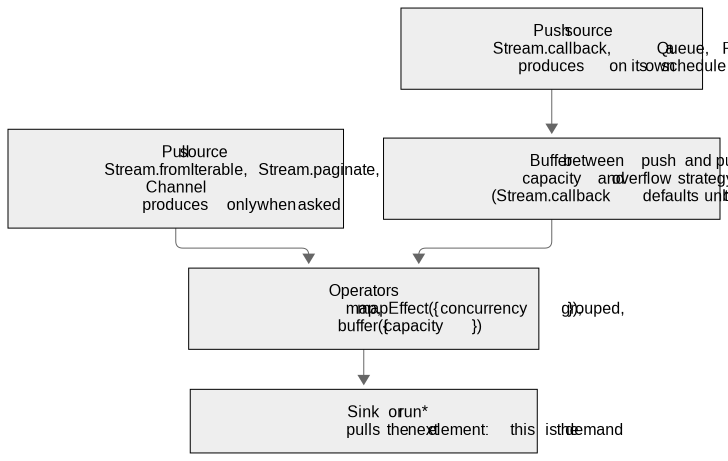
A stream runs on demand: the sink pulls, and each operator pulls from its source. A push source needs a buffer between itself and that demand, with an explicit capacity and overflow strategy.
Stream
effect/Stream — stable
Stream<A, E, R> is a lazy, pull-based, possibly-infinite sequence of As that can fail with E and needs services R. Pulling provides automatic back-pressure and supports constant-memory pipelines when each stage keeps bounded state. Collecting, unbounded grouping/buffering, or letting producers outrun consumers can still consume memory proportional to the data. Combinators cover three operations — create, transform, run — and the later subsections cover combining streams, failure handling, resource ownership, and where buffering hides.
1. Creating streams
| Source type | Constructor |
|---|---|
| In-memory data | fromIterable / fromArray / make; fromArrays emits one chunk per array |
| One effect, one constant, one failure | fromEffect / succeed / fail (also failCause, die, empty, never) |
| Effect that returns a collection | fromIterableEffect — "call the repository, then stream the rows" |
| Effect that returns a stream | unwrap — also the way to own a resource |
| Repeat one effect, or a whole stream | fromEffectRepeat / forever / repeat(schedule) |
| Effectful, scheduled polling | fromEffectSchedule |
| Cursor-based API pagination | paginate |
| Async iterator | fromAsyncIterable |
| DOM event / callback | fromEventListener / callback |
| Concurrency primitives | fromQueue / fromPubSub |
Web ReadableStream | fromReadableStream |
Node.js Readable | NodeStream.fromReadable from @effect/platform-node |
| Schedule outputs | fromSchedule |
| Manual seed-and-step | unfold |
| Counters / timers | range / iterate / tick |
Async iterator cancellation has a host boundary. fromAsyncIterable calls the iterator's return() on early scope closure. If next() is still pending, it does not await that return: an async generator's own finally may not run until the pending pull settles. Stream.timeout / timeoutOrElse can therefore finish without hanging on an unresolved pull, but cannot force an arbitrary JavaScript Promise to settle. Make the iterator's underlying I/O independently abortable when cleanup must be prompt.
Self-contained source · Type-checked
import { Array, Cause, Clock, Effect, Option, Queue, Schedule, Schema, Stream } from "effect"

// In-memory headcount snapshot — the simplest constructor.
const levels = Stream.fromIterable<string>(["IC3", "IC4", "IC5", "M1", "M2"])
const bandLiterals = Stream.make("IC3", "IC4", "IC5") // varargs -> Stream<string>

// Poll the HRIS health endpoint on a schedule.
// (v4 name: fromEffectSchedule, NOT repeatEffectWith.)
const hrisHeartbeat = Stream.fromEffectSchedule(
  Clock.currentTimeMillis.pipe(
    Effect.map((ts) => ({ status: "ok", ts }))
  ),
  Schedule.spaced("30 seconds")
)

// Walk the HRIS's cursor-paginated /employees endpoint.
// paginate(initialCursor, f) where f returns [thisPage, Option<nextCursor>].
const allEmployees = Stream.paginate(
  0, // start at page 0
  Effect.fn(function*(page: number) {
    yield* Effect.sleep("50 millis") // simulate network round-trip
    const rows = Array.range(0, 99).map((i) => ({
      id: `emp_${page * 100 + i}`,
      name: `Employee ${page * 100 + i}`,
      level: "IC4"
    }))
    const next = page < 10 ? Option.some(page + 1) : Option.none()
    return [rows, next] as const
  })
)

// Any callback/event API: the Queue is the whole protocol — offer values,
// end it to finish, fail it to fail the stream.
class HrisUnavailable extends Schema.TaggedError<HrisUnavailable>()("HrisUnavailable", {
  cause: Schema.Defect()
}) {}

const PayrollEvent = Schema.Struct({ runId: Schema.String, status: Schema.String })
const decodePayrollEvent = Schema.decodeUnknownOption(Schema.fromJsonString(PayrollEvent))

// Bridge a WebSocket that streams live payroll-run events into a typed Stream.
const payrollEvents = Stream.callback<typeof PayrollEvent.Type, HrisUnavailable>(
  Effect.fn(function*(queue) {
    const ws = new WebSocket("wss://hris.example.com/payroll-events")
    const onMessage = (e: MessageEvent) => {
      // Decode at the boundary instead of casting JSON.parse output.
      const event = decodePayrollEvent(e.data)
      // A listener cannot wait, so it cannot use the suspending Queue.offer.
      if (Option.isSome(event)) Queue.offerUnsafe(queue, event.value)
    }
    const onClose = () => Queue.endUnsafe(queue) // buffered events drain, then the stream ends
    const onError = (cause: Event) =>
      Queue.failCauseUnsafe(queue, Cause.fail(new HrisUnavailable({ cause })))
    // The callback effect runs in the stream's scope: this release runs when the
    // consumer finishes, fails, stops early, or is interrupted.
    yield* Effect.acquireRelease(
      Effect.sync(() => {
        ws.addEventListener("message", onMessage)
        ws.addEventListener("close", onClose)
        ws.addEventListener("error", onError)
      }),
      () =>
        Effect.sync(() => {
          ws.removeEventListener("message", onMessage)
          ws.removeEventListener("close", onClose)
          ws.removeEventListener("error", onError)
          ws.close()
        })
    )
  }),
  // Without bufferSize the buffer is UNBOUNDED. Status events supersede each
  // other, so keep the newest 256 and evict the oldest under pressure.
  { bufferSize: 256, strategy: "sliding" }
)
Warning:
Stream.callback(andStream.fromEventListener, which is built on it) buffers without bound unless you passbufferSize: a fast emitter plus a slow consumer grows the heap silently. The strategy defaults to"suspend", but suspension only helps a producer that canyield* Queue.offer(...). A synchronous listener callsQueue.offerUnsafe, which never waits and returns abooleaninstead.
strategy | offerUnsafe on a full buffer | What is lost |
|---|---|---|
"suspend" (default) | returns false; the value is not enqueued | the newest value — silently, unless the listener checks the boolean |
"dropping" | returns false; the value is not enqueued | the newest value — the stated policy |
"sliding" | returns true; evicts the oldest buffered value | the oldest value |
For a push source the real choices are a stated loss policy ("dropping" or "sliding", ideally with a counter on every false), pausing the source externally, or restructuring so the producer is an Effect that awaits a bounded Queue and the stream is Stream.fromQueue. "No loss" together with "the producer cannot slow down" needs durable storage, not a bigger buffer. fromEventListener accepts bufferSize but no strategy, so a full buffer drops the newest events; with { once: true } it ends the stream after the first event. Queue and PubSub overload semantics are covered in Concurrency & Coordination.
unfold vs paginate. The unfold step is always effectful and returns [element, nextState], or undefined to stop — exactly one element per step. paginate returns a whole page plus Option<nextState> and still emits the last page when the next state is None, which is why it fits page-shaped APIs. There is no unfoldEffect or paginateEffect.
Ending a repeated effect. Stream.fromEffectRepeat(effect) re-runs an effect forever, one element per run. Fail it with Cause.done() to end the stream normally — the way to drain an imperative iterator or cursor without carrying unfold state (see Pull for the Done signal).
Self-contained source · Type-checked
import { Cause, Effect, Stream } from "effect"

// Drain any iterator lazily: one `next()` per pull, normal end on `done`.
const drainIterator = <A>(iterator: Iterator<A>): Stream.Stream<A> =>
  Stream.fromEffectRepeat(
    Effect.suspend(() => {
      const next = iterator.next()
      return next.done ? Cause.done() : Effect.succeed(next.value)
    })
  )
Official guide: Creating Streams (its callback example passes no buffer options, and its "void" heading is not an API — use Stream.succeed(undefined)).
2. Transforming streams
| Need | Operators | Semantics that decide the choice |
|---|---|---|
| Per element, pure | map / as / filter / filterMap | as(value) replaces every element with a constant. filterMap takes a Filter (returns a Result), not an Option-returning function. |
| Per element, effectful | mapEffect / tap | mapEffect accepts { concurrency, unordered }; ordered output is the default. |
| Fan out per element | flatMap / switchMap / flattenIterable | flatMap runs every inner stream to completion. switchMap interrupts the previous inner stream when the outer emits again — stale work is cancelled, not queued. flattenIterable is the inverse of grouped. |
| Carry state | scan / mapAccum (scanEffect, mapAccumEffect) | scan(() => initial, f) emits the seed and every intermediate value — for an empty stream, just the seed is emitted. Its seed (and scanEffect's) is a thunk, like mapAccum's. mapAccum(() => initial, (state, a) => [next, outputs]) returns an array of outputs, so one input can emit zero, one, or many; { onHalt } flushes leftover state at the end. Both keep one caller-supplied accumulator; memory is bounded only if that accumulator is bounded. |
| Stop early | take / takeWhile / takeUntil / takeRight / haltWhen / interruptWhen | takeWhile stops before the first failing element; takeUntil includes the element that matched unless { excludeLast: true }. takeRight(n) must see the end, so it buffers n and never emits on an infinite source. haltWhen(effect) stops before the next pull; interruptWhen(effect) also interrupts the pull in progress. |
| Batch | grouped(n) / groupedWithin(n, duration) / rechunk(n) | grouped flushes only when n elements arrived or the stream ended. groupedWithin flushes on size or elapsed time, whichever is first — the right shape for live feeds. Its window starts with the first element of a batch: idle time before that element is excluded, but silence after a partial batch starts still advances its timer. For schedule-driven aggregation, schedule exhaustion can drain already-pulled leftovers into further batches without more upstream pulls. rechunk resizes the internal chunks without changing the element type. |
| Rate control | throttle / debounce(duration) / schedule(schedule) | throttle is a token bucket charged per chunk via cost(chunk): "shape" delays, "enforce" drops the whole over-budget chunk (rechunk(1) first for per-element dropping), burst raises the bucket to units + burst. debounce emits only the last value after a quiet period. schedule spaces every element by a Schedule. |
| Keyed sub-streams | groupByKey(f) / groupBy | Emits [key, Stream] pairs; consume them with flatMap(..., { concurrency: "unbounded" }) or a finite bound. Each key owns a queue (bufferSize, default 4096 elements); idleTimeToLive retires quiet keys, which matters when the key space is large. If a substream consumer stops early, the underlying queue is shut down so the source is not left hanging; when the upstream ends or fails, every open group ends too. |
| Dedupe | changes | Drops consecutive elements that are Equal.equals. |
| Runs of equal keys | groupAdjacentBy(f) | Emits [key, NonEmptyArray] for each run of consecutive elements whose keys are Equal.equals; a later run with the same key is a separate group. It holds only the current run, and when upstream fails the run in progress is emitted before the error. |
| Text framing | decodeText / splitLines / encodeText | decodeText decodes incrementally, so a multi-byte character may straddle chunks; on normal completion an incomplete trailing character becomes U+FFFD (Channel.decodeText(encoding, { fatal: true }) turns it into a defect instead). splitLines accepts \n, \r\n, and a lone \r, and carries an incomplete line to the next pull. |
| Shape the output | drain / intersperse | drain keeps a stream's effects but emits nothing, so it can be merged in as a background side-stream. intersperse inserts a separator between elements. |
Fragment · Type-checked
import { Effect, Stream } from "effect"

interface Employee {
  readonly id: string
  readonly level: string
  readonly baseSalary: number
  readonly active: boolean
}

interface CompBand {
  readonly level: string
  readonly min: number
  readonly mid: number
  readonly max: number
}

declare const lookupCompBand: (level: string) => Effect.Effect<CompBand>

// Process a payroll batch: filter active employees, enrich with comp bands,
// throttle to avoid hammering the CompService, then batch for bulk writes.
const payrollBatch = (employees: Stream.Stream<Employee>) =>
  employees.pipe(
    // pure filter: active headcount only
    Stream.filter((e) => e.active),
    // pure transform: tag employees outside their band
    Stream.map((e) => ({ ...e, flagged: false as boolean })),
    // effectful enrichment with bounded concurrency (v4 sweet spot: one operator, one option)
    Stream.mapEffect(
      Effect.fn("enrichWithBand")(function*(e) {
        const band = yield* lookupCompBand(e.level)
        const inBand = e.baseSalary >= band.min && e.baseSalary <= band.max
        return { ...e, band, flagged: !inBand }
      }),
      { concurrency: 8 }
    ),
    // rate-limit: charge 1 unit per element, cap at 100/second, shape (don't drop)
    Stream.throttle({
      cost: (chunk) => chunk.length,
      units: 100,
      duration: "1 second",
      strategy: "shape"
    }),
    // batch into arrays of up to 200 for a bulk DB upsert
    Stream.grouped(200)
  )
Tip:
mapEffect,flatMap, andmergeAllall accept{ concurrency: n }or{ concurrency: "unbounded" }, but onlymapEffecthasunordered: its output keeps input order unless{ unordered: true }is passed.flatMapandmergeAlltake{ concurrency, bufferSize }; above a concurrency of 1 their inner streams interleave as elements arrive, and there is no flag to restore a cross-stream order. In-flight fibers are interrupted when downstream stops pulling.
Ordered does not mean serialized. Ordered mapEffect with concurrency: 8 still runs eight effects at once and only emits in input order, so a slow head element holds back finished successors. Choose unordered: true when downstream does not care, and serialize only the stage whose order is contractual.
Batch by size or time on live sources. A partial grouped(n) batch waits for more input indefinitely, so on a queue- or socket-backed stream latency becomes unbounded. groupedWithin(n, duration) is aggregateWithin(Sink.take(n), Schedule.spaced(duration)) underneath; reach for Stream.aggregateWithin directly when the batch boundary is a custom Sink.
Fragment · Type-checked
import { Stream } from "effect"

declare const auditEvents: Stream.Stream<{ readonly id: string }>

// Flush at 200 events or after 2 seconds of accumulation, whichever is first.
const auditBatches = auditEvents.pipe(Stream.groupedWithin(200, "2 seconds"))
Official guide: Stream operations (its "mergeWith" heading and the switch option it mentions for flatMap are not current APIs — use Stream.merge over mapped inputs and Stream.switchMap).
3. Running streams
| Runner | Behavior |
|---|---|
runCollect | Gathers all elements into an array (bounded streams only). |
runDrain | Executes for effects, discards output. |
runForEach | Runs an effect per element. runForEachArray runs it once per pulled chunk. |
runForEachWhile | Runs an Effect<boolean> per element and stops pulling on the first false. v4 has no early-exit fold, so this plus local state is the replacement. |
runFold | Reduces to one value; the initial state is a thunk. runFoldEffect for an effectful step. |
runHead / runLast / runCount / runSum | One-value shortcuts. runHead stops after the first element; the other three consume the whole stream. |
mkString / mkUint8Array / mkArrayBuffer | Concatenate a text or byte stream into one value — a full materialization, like runCollect. |
run(sink) | Hands the stream to an arbitrary Sink. |
Fragment · Type-checked
import { Effect, Sink, Stream } from "effect"

interface RaiseRecommendation {
  readonly employeeId: string
  readonly newSalary: number
  readonly approved: boolean
}

declare const recommendations: Stream.Stream<RaiseRecommendation>
declare const persistRaise: (r: RaiseRecommendation) => Effect.Effect<void>

const program = Effect.gen(function*() {
  // collect — bounded only; use for small review batches
  const allRaises = yield* Stream.runCollect(recommendations)

  // drain — run for side effects, discard output
  yield* recommendations.pipe(
    Stream.tap((r) => Effect.logInfo(`processing raise for ${r.employeeId}`)),
    Stream.runDrain
  )

  // fold — reduce approved raises to a total payroll delta
  const totalDelta = yield* recommendations.pipe(
    Stream.filter((r) => r.approved),
    Stream.runFold(() => 0, (acc, r) => acc + r.newSalary)
  )

  // run into a Sink — the general escape hatch
  const approvedCount = yield* recommendations.pipe(
    Stream.filter((r) => r.approved),
    Stream.run(Sink.count)
  )

  return { totalRaises: allRaises.length, totalDelta, approvedCount }
})
Limit demand, not the result. Stream.take(n) placed before the runner stops pulling after n elements and finalizes the source. runCollect followed by slice(0, n) has already drained the source — and never returns for a live one. Against a six-row counting source, take(2) before runCollect performs 2 reads; runCollect followed by slice(0, 2) performs all 7 (six rows plus the read that discovers the end). The finalizer runs once either way, so only a read counter tells the two apart.
Fragment · Type-checked
import { Effect, Stream } from "effect"

declare const employeeIds: Stream.Stream<string> // live HRIS feed: never ends on its own
declare const loadProfile: (id: string) => Effect.Effect<{ readonly id: string }>

// Demand-limited: ten ids pass `take`, so exactly ten profiles are loaded.
const firstTen = employeeIds.pipe(
  Stream.take(10),
  Stream.mapEffect(loadProfile, { concurrency: 4 }),
  Stream.runCollect
)

// Same ten results, but take sits AFTER the concurrent stage: its window stays
// full, so extra lookups have already started when the tenth result arrives.
// They are interrupted, but the HRIS has already seen the requests.
const overshoots = employeeIds.pipe(
  Stream.mapEffect(loadProfile, { concurrency: 4 }),
  Stream.take(10),
  Stream.runCollect
)
Three details keep this honest. Demand is per chunk, not per element: Stream.fromIterable reads up to chunkSize items (default 4096) from a lazy iterable per pull, so take(2) over it still advances the iterator by a whole chunk — pass { chunkSize } or use unfold/paginate when each read is expensive. The deciding element has already been processed: takeUntil, takeWhile, and runForEachWhile see an element before they can stop, so "stop before the budget is exceeded" must test the projected total. take treats NaN and non-positive counts as zero and returns an empty stream.
For byte streams, Stream.limitBytes(limit, onLimitReached) emits chunks until the next one would cross limit (any ByteSize.Input), drops that crossing chunk, and switches to the fallback stream — pass a fallback that is Stream.fail(...) to make an oversized body a typed error, or () => Stream.empty to truncate silently. Stream.mkArrayBuffer collects an ArrayBuffer without losing the concrete backing-buffer type. Web Streams are first-class: Stream.fromReadableStream bridges a browser/WHATWG source, while the Channel layer below also supports writable and transform streams. In Node, NodeStream.fromReadable({ evaluate, onError, closeOnDone? }) lazily evaluates a node:stream Readable, maps its errors into the typed channel, and closes it when done by default; see Platform & Runtime Hosts.
Official guide: Consuming Streams.
4. Combining and splitting streams
| Goal | Operator | Termination and ordering |
|---|---|---|
| One after the other | concat / flatten (stream of streams) | The right side does not start until the left ends. |
| Both at once | merge(that, { haltStrategy }) / mergeAll({ concurrency, bufferSize }) | Arrival order; each side keeps its own order. Default haltStrategy is "both": merging a finite stream with an infinite ticker never ends unless you pass "left", "right", or "either". |
| Pair positionally | zip / zipWith | Ends with the shorter side, so the faster side is back-pressured to the slower one. |
| Pair with the latest | zipLatest / zipLatestWith | Emits when either side produces, after both have produced once. "Latest" is tracked per pulled chunk, so only the last element of each chunk is paired. |
| Pair with neighbors | zipWithIndex / zipWithPrevious / zipWithNext | The neighbor is an Option; no manual counter or mapAccum needed. |
| Alternate deterministically | interleave | Unlike merge, the order does not depend on timing. |
| Every combination | cross | Re-runs the right stream once per left element — expensive if the right side does I/O. |
| Two branches by a rule | partition(filter) / partitionEffect(filter) | Returns a scoped Effect of two queue-backed streams. Both yield [passes, fails] (the passing branch first) and take a capacity option: default 16 for partition, 4096 for partitionEffect. Swapped names still type-check when both branches share a type, so double-check the destructuring order against the tuple position, not the variable name. A consumer that stops early shuts down its queue so the other branch and the source are not left hanging. |
| Same elements to several consumers | broadcastN({ n, capacity }) / broadcast / share | Running one Stream value twice runs its source twice. These run it once behind a PubSub: with the default "suspend" strategy the source advances at most capacity chunks ahead of the slowest consumer. share is the ref-counted variant: upstream starts with the first subscriber and is finalized after the last by default; configured idleTimeToLive retains it until expiry or owner-scope closure. |
Fragment · Type-checked
import { Effect, Filter, Stream } from "effect"

interface RaiseRequest {
  readonly employeeId: string
  readonly percent: number
}

declare const requests: Stream.Stream<RaiseRequest> // finite: one merit cycle
declare const approve: (request: RaiseRequest) => Effect.Effect<void>
declare const escalate: (request: RaiseRequest) => Effect.Effect<void>

// A progress ticker must not keep the merged stream alive after the data ends.
const withProgressTicks = Stream.merge(
  requests.pipe(Stream.map((request) => ({ _tag: "Request" as const, request }))),
  Stream.tick("5 seconds").pipe(Stream.map(() => ({ _tag: "Tick" as const }))),
  { haltStrategy: "left" }
)

const withinPolicy = Filter.fromPredicate((request: RaiseRequest) => request.percent <= 10)

const triage = Effect.scoped(
  Effect.gen(function*() {
    // The passing branch comes first: [passes, fails].
    const [inPolicy, overPolicy] = yield* Stream.partition(requests, withinPolicy, { capacity: 64 })
    // Both halves are bounded queues fed by one source: drain them concurrently,
    // or the branch nobody reads fills up and stalls the other one too.
    yield* Effect.all(
      [Stream.runForEach(inPolicy, approve), Stream.runForEach(overPolicy, escalate)],
      { concurrency: 2, discard: true }
    )
  })
)
Use when one pipeline must feed two policies (partition), two independent consumers (broadcastN), or must be joined with a clock, a config feed, or a fallback (merge, zipLatest, concat). For fan-out across fibers that outlive one pipeline, use a PubSub directly.
5. Handling stream failures
A stream failure is terminal for the failed region. Recovery never resumes the broken source: it appends a different stream after the elements that were already delivered, so a non-idempotent consumer has already seen them.
| Operator | Recovers from | Notes |
|---|---|---|
catch | every typed failure | Removes E; the handler returns the fallback stream. |
catchTag / catchTags | tagged failures by _tag | Other failures stay in E. catchTags rejects keys that are not tags of E, as Effect.catchTags does. |
catchIf / catchFilter | failures selected by a predicate, refinement, or Filter | Optional trailing orElse for the rest, as on Effect.catchIf. |
catchCause / catchCauseFilter | the full Cause, defects included | Use when defects must be handled too. |
catchDefect | defects only | Typed failures and interruption pass through untouched — the narrow tool for "a parser threw". |
orElseSucceed / orElseIfEmpty | any typed failure / an empty stream | Append one element computed from the error, or switch streams when nothing was emitted. |
mapError / mapBoth / orDie | — | Translate the error (mapBoth({ onElement, onError }) maps elements too), or turn it into a defect. |
onError / tapError / tapErrorTag / tapCause / tapDefect | — | Observation only: run an effect, then re-raise. tapErrorTag and tapDefect mirror their Effect namesakes. |
unwrapReason(tag) | — | Replaces a tagged error with its nested reason, so catchTag can target each reason, as Effect.unwrapReason does. |
retry(schedule) | typed failures the schedule accepts | Re-runs the entire upstream region, re-acquiring its resources. The schedule resets as soon as the restarted stream emits one element, so upTo({ times: 5 }) means five consecutive failed attempts, not five over the feed's lifetime. |
timeout(duration) | — | Ends the stream with no error when one pull waits longer than duration. |
timeoutOrElse({ duration, orElse }) | — | Switches to orElse() instead: Stream.fail(...) makes silence a typed failure; any other stream is a fallback source. |
Fragment · Type-checked
import { Effect, Schedule, Schema, Stream } from "effect"

class FeedUnavailable extends Schema.TaggedError<FeedUnavailable>()("FeedUnavailable", {
  reason: Schema.String
}) {}

class HeartbeatLost extends Schema.TaggedError<HeartbeatLost>()("HeartbeatLost", {}) {}

interface Approval {
  readonly employeeId: string
  readonly approved: boolean
}

declare const liveApprovals: Stream.Stream<Approval, FeedUnavailable>
declare const cachedApprovals: Stream.Stream<Approval>

const resilientApprovals = liveApprovals.pipe(
  // Silence is a failure for this feed, not a normal end.
  Stream.timeoutOrElse({
    duration: "30 seconds",
    orElse: () => Stream.fail(new HeartbeatLost())
  }),
  // Observe and re-raise; onError never recovers.
  Stream.onError((cause) => Effect.logWarning("live approvals failed", cause)),
  // Reconnect: re-runs everything above, including the socket acquisition.
  Stream.retry(Schedule.exponential("1 second").pipe(Schedule.jittered, Schedule.upTo({ times: 5 }))),
  // Still failing: append the cache. Approvals already emitted stay emitted.
  Stream.catchTag("FeedUnavailable", () => cachedApprovals)
)
// Stream<Approval, HeartbeatLost>
Warning:
Stream.timeoutdoes not behave likeEffect.timeout. It istimeoutOrElsewithStream.emptyas the fallback, so downstream cannot tell "the source finished" from "the source went quiet". The deadline is an idle timeout per pull, not a total budget — a feed that emits every 30 ms runs forever undertimeout("50 millis")— and the fallback stream itself is not timed.
Two placement rules follow from "retry re-runs the upstream region". Place retry directly after the source it should reconnect, upstream of any non-idempotent write — everything above it in the pipe runs again on each attempt (see the streaming deep dive). Put per-element recovery inside the element's effect — Stream.mapEffect((row) => write(row).pipe(Effect.catchTag(...))) keeps the stream alive, whereas a Stream.catch* after it can only replace the rest of the stream. Retry classification and backoff policy are ordinary Schedule material.
Official guide: Error handling in streams (its "timeoutFail", "timeoutFailCause", and "timeoutTo" headings are stale names; the code under them uses Stream.timeoutOrElse).
6. Owning resources inside a stream
A file handle, database cursor, or subscription behind a stream must stay open until the consumer stops pulling — and must close on completion, failure, interruption, and early stop. Acquire inside the stream, never before it: a handle opened outside and closed "when the consumer is done" leaks on the first take(n) or decode failure. There is no Stream.acquireRelease; compose Effect.acquireRelease with one of these:
| Tool | Shape | Scope lifetime |
|---|---|---|
Stream.unwrap(effect) | an Effect that returns a Stream | The effect's Scope is removed from R and lives as long as the returned stream. The default choice. |
Stream.scoped(stream) | a stream whose stages need Scope | Opens a scope for the wrapped stream and closes it when that stream ends. |
Stream.ensuring(finalizer) / Stream.onExit(f) | no resource, just cleanup | Runs after the stream's own finalizers on every exit path. An early stop such as take reports a Success exit. |
Fragment · Type-checked
import { Cause, Effect, Option, Schema, Stream } from "effect"

class ExportUnavailable extends Schema.TaggedError<ExportUnavailable>()("ExportUnavailable", {
  path: Schema.String
}) {}

interface PayrollExportCursor {
  // One read per pull. The reader itself is lazy: None means end of export.
  readonly nextRow: Effect.Effect<Option.Option<string>, ExportUnavailable>
  readonly close: Effect.Effect<void>
}

declare const openPayrollExport: (
  path: string
) => Effect.Effect<PayrollExportCursor, ExportUnavailable>

// The cursor opens on the first pull and closes exactly once: on completion,
// on failure, on interruption, and when a consumer stops early with take(n).
const payrollExportRows = (path: string): Stream.Stream<string, ExportUnavailable> =>
  Stream.unwrap(
    Effect.acquireRelease(openPayrollExport(path), (cursor) => cursor.close).pipe(
      Effect.map((cursor) =>
        Stream.fromEffectRepeat(
          Effect.flatMap(
            cursor.nextRow,
            Option.match({ onNone: () => Cause.done(), onSome: (row) => Effect.succeed(row) })
          )
        )
      )
    )
  ).pipe(Stream.ensuring(Effect.logInfo("payroll export stream finished")))

// Stream.scoped: wrap EVERY stage that uses the handle.
declare const openCursor: Effect.Effect<PayrollExportCursor, ExportUnavailable>
declare const readAll: (cursor: PayrollExportCursor) => Stream.Stream<string, ExportUnavailable>

const scopedRows = Stream.scoped(
  Stream.fromEffect(Effect.acquireRelease(openCursor, (cursor) => cursor.close)).pipe(
    Stream.flatMap(readAll)
  )
)
Warning: Scope placement is the whole contract.
Stream.scoped(Stream.fromEffect(acquire)).pipe(Stream.flatMap(readAll))wraps only the one-element stream, so the handle closes as soon as that stream is exhausted. With a sequentialflatMapthe pull order happens to hide it; with{ concurrency: 2 }the release runs before the first row is read.
Two more rules. The reader must itself be lazy: a "stream" over an array produced by reading the whole file only disguises the all-at-once read. Treat explicit completion as end-of-stream, not one successful pull, and never reuse a possible element (or undefined) as an internal "done" sentinel — end with Cause.done(), Option.none(), or the constructor's own protocol. To prove the contract, assert the release flag rather than the values; the streaming deep dive has the three tests.
Official guide: Resourceful streams.
7. Where buffering hides
Pull-based back-pressure bounds a pipeline only if every stage is bounded. Each row is a place where elements wait; peak memory is roughly the sum of capacity × largest item over all of them, and one unbounded row voids the claim.
| Stage | What it retains | Default | How to bound it |
|---|---|---|---|
Stream.callback, Stream.fromEventListener | values pushed but not yet pulled | unbounded | bufferSize (+ strategy on callback) |
Stream.fromQueue, Stream.fromPubSub | whatever the queue or subscription holds | the capacity it was built with | construct it bounded / dropping / sliding; see Queue |
Stream.buffer({ capacity }) | up to capacity elements, plus what is in flight on either side | required; "unbounded" must be spelled out | finite capacity; "suspend" (default) back-pressures, "dropping" / "sliding" lose data |
Stream.bufferArray({ capacity }) | up to capacity chunks | required | bound is capacity × max chunk size |
mapEffect(f, { concurrency }) | up to concurrency inputs and results in flight | sequential | finite concurrency; "unbounded" is unbounded memory |
flatMap / mergeAll with concurrency above 1 | the running inner streams plus one output queue | bufferSize: 16; sequential flatMap has no queue | finite concurrency and bufferSize |
grouped(n), groupedWithin(n, d) | the batch under construction | n | choose n from the destination's bulk limit |
groupByKey / groupBy | one queue per live key | 4096 per key, keys never retired | bufferSize, idleTimeToLive |
partition / partitionEffect | two queues | 16 / 4096 | capacity |
broadcast, broadcastN, share | a PubSub | capacity is required | finite capacity; the slowest consumer sets the pace |
takeRight(n), debounce, zipLatest | the last n / the latest value | — | inherently bounded |
runCollect, Sink.collect(), mkString, mkUint8Array | everything | — | only on sources you know are small; otherwise fold, take, or a bounded Sink |
Framing decoders (splitLines, Ndjson, Sse, SchemaBinary) | one incomplete line, event, or frame | Ndjson and splitLines: no limit; Sse: 10 MiB; SchemaBinary: unset | maxEventSize, maxFrameSize, or Stream.limitBytes upstream |
| Source chunk size | one pulled chunk | fromIterable: 4096 elements; FileSystem.stream: 64 KiB | the source's chunkSize option |
Buffer capacity is not batch size. Stream.buffer({ capacity: 3 }) sets flow-control depth: the arrays a downstream Sink.forEachArray or runForEachArray receives are whatever happened to be queued — one element at a time behind a slow producer, up to the capacity behind a fast one. Effectful stages reshape chunks too: everything after mapEffect arrives in chunks of one. When the destination needs batches of n, put Stream.grouped(n) (arrays as elements) or Stream.rechunk(n) (chunk size) immediately before the consumer.
buffer also runs ahead of demand. source.pipe(Stream.buffer({ capacity: 64 }), Stream.take(1)) still reads dozens of elements from source; take(1) before the buffer reads one. Place take upstream of buffers and concurrent stages when each read costs something.
The end-to-end version of this inventory, with a memory equation and tests, is Streaming Ingestion Without Accidental Buffering.
Use when you need back-pressured, incrementally-produced data with typed errors and bounded concurrency; choose bounded-state operators when constant-memory behavior matters.
Sink
effect/Sink — stable
Sink<A, In, L, E, R> consumes elements of type In, may fail with E, needs R, and produces a result A plus unconsumed leftover L. The leftover slot enables early termination without discarding unused elements — two sinks can be sequenced so the second picks up exactly where the first stopped.
Key APIs: Sink.sum, Sink.count, Sink.head(), Sink.last(), Sink.take(n), Sink.fold, Sink.reduce, Sink.forEach, Sink.drain. The collect-all sink is Sink.collect() (function call, not Sink.collectAll).
| Group | Sinks | Notes |
|---|---|---|
| Consume everything | collect(), count, sum, last(), drain, reduce, reduceArray, forEach, forEachArray, timed | forEachArray runs once per pulled chunk, whatever size that is. timed drains and returns the elapsed Duration. |
| Stop early (bounded) | head(), take(n), takeWhile, takeUntil, find, every, some, fold, foldUntil, reduceWhile, forEachWhile | All but forEachWhile report leftovers (L = In). fold(initial, continueWhile, step) has a lazy seed and an effectful step; reduceWhile is the pure form and also covers size-capped set/map collection; foldUntil(initial, max, step) stops after max inputs. |
| No input needed | succeed, fail, die, never | Finish (or not) without pulling. |
| Adapt | map / mapEffect (result), mapInput / mapInputEffect / mapInputArray (input), mapError, mapEnd, ignoreLeftover, flatMap, orElse | mapInput is what makes a generic sink reusable across element types. |
Self-contained source · Type-checked
import { Effect, Sink, Stream } from "effect"

interface MeritRecommendation {
  readonly employeeId: string
  readonly currentSalary: number
  readonly recommendedSalary: number
}

// Built-in folds run with Stream.run.
const recCount = Stream.make(
  { employeeId: "e1", currentSalary: 100_000, recommendedSalary: 105_000 },
  { employeeId: "e2", currentSalary: 120_000, recommendedSalary: 126_000 }
).pipe(Stream.run(Sink.count)) // Effect<number> = 2

const firstRec = Stream.make(
  { employeeId: "e1", currentSalary: 100_000, recommendedSalary: 105_000 }
).pipe(Stream.run(Sink.head<MeritRecommendation>())) // Effect<Option<MeritRecommendation>>

// A custom Sink: compute the arithmetic mean merit percentage in one pass.
// Sink.reduceArray folds whole pulled arrays into state — efficient batch-at-a-time.
const averageIncreasePct = Sink.reduceArray<
  { totalPct: number; n: number },
  MeritRecommendation
>(
  () => ({ totalPct: 0, n: 0 }),
  (acc, batch) => {
    let { totalPct, n } = acc
    for (const r of batch) {
      totalPct += (r.recommendedSalary - r.currentSalary) / r.currentSalary
      n += 1
    }
    return { totalPct, n }
  }
).pipe(Sink.map(({ totalPct, n }) => (n === 0 ? 0 : (totalPct / n) * 100)))

// Run: average merit increase percentage across all recommendations.
const avgIncrease = Stream.make(
  { employeeId: "e1", currentSalary: 100_000, recommendedSalary: 105_000 },
  { employeeId: "e2", currentSalary: 120_000, recommendedSalary: 126_000 }
).pipe(Stream.run(averageIncreasePct)) // Effect<number> ≈ 5.0

// Sinks can do effects — forEach turns a per-element effect into a Sink.
const auditLog = Sink.forEach((r: MeritRecommendation) =>
  Effect.logInfo(`merit rec: ${r.employeeId} -> ${r.recommendedSalary}`)
)
const _audit = Stream.make(
  { employeeId: "e1", currentSalary: 100_000, recommendedSalary: 105_000 }
).pipe(Stream.run(auditLog))
Adapting, leftovers, and repeatable batching
A sink's error handlers see only the sink's own failures. In Stream.run, Stream.peel, and Stream.aggregate / aggregateWithin, an upstream stream failure reaches the caller unchanged: Sink.mapError, Sink.catch, Sink.catchCause, and Sink.orElse do not remap or recover it, and Sink.onExit observes it as an interruption of the sink. Handle source failures on the stream (Stream.catch*, Stream.retry) before it reaches the sink.
Sink.mapInput adapts the input; Sink.map adapts the result. Write the aggregation once over a primitive and reuse it across streams of different shapes.
Leftovers are the rest of the chunk already pulled — not the rest of the stream. A sink finishes with an End tuple [result, leftover?]. Sink.mapEnd can read and rewrite both halves, Sink.ignoreLeftover narrows L to never, and Sink.flatMap hands the first sink's leftovers to the second, so "parse a header, then fold the body" composes. Because leftovers depend on chunking, Sink.take(3) over Stream.make(1, 2, 3, 4, 5) (one chunk) leaves [4, 5], but over chunks [1, 2], [3, 4], [5] it leaves [4]. Ignoring leftovers never pulls more input.
Sink.takeUntil(predicate) and takeUntilEffect include the matching element, stop there immediately, and return the rest of that chunk as leftovers. They do not consume and drop an extra element after the match; this matters when composing parsers or repeatedly transducing a delimiter-based sink.
Stream.transduce(sink) re-applies a sink as an operator. Stream.run(sink) applies it once; transduce runs it repeatedly, feeds each run's leftovers into the next, and emits every result — this is why L exists. transduce(Sink.take(n)) is fixed-size batching; a Sink.fold whose predicate looks at accumulated cost gives weighted batching (there is no Sink.foldWeighted). Two edges: the element that crosses the limit is already in the batch, and an empty trailing result can be emitted when the input ends on a batch boundary, so filter empties.
Fragment · Type-checked
import { Effect, Sink, Stream } from "effect"

interface Raise {
  readonly employeeId: string
  readonly delta: number
}

// One generic sink, adapted to a domain record.
const totalRaiseDelta = Sink.sum.pipe(Sink.mapInput((raise: Raise) => raise.delta))

// Header row first, then count the body: flatMap passes the leftovers along.
const headerThenRowCount = Sink.take<string>(1).pipe(
  Sink.flatMap(([header]) => Sink.count.pipe(Sink.map((rows) => ({ header, rows }))))
)

// Flush once roughly 1 MiB of UTF-8 row payload has accumulated.
// The last row can overshoot the threshold; framing bytes are not counted.
const encoder = new TextEncoder()
const upToOneMiB = Sink.fold<{ readonly rows: ReadonlyArray<string>; readonly bytes: number }, string>(
  () => ({ rows: [], bytes: 0 }),
  (state) => state.bytes < 1_048_576,
  (state, row) => Effect.succeed({ rows: [...state.rows, row], bytes: state.bytes + encoder.encode(row).byteLength })
).pipe(Sink.map((state) => state.rows))

declare const exportRows: Stream.Stream<string>

const byteWeightedBatches = exportRows.pipe(
  Stream.transduce(upToOneMiB),
  Stream.filter((batch) => batch.length > 0)
)
Sink.forEachArray does not create batches. It receives whatever arrays the stream happens to pull, and neither it nor Stream.buffer({ capacity }) sets a batch size — see Where buffering hides. Put Stream.rechunk(n) (or Stream.grouped(n) with runForEach) directly before it when the destination needs batches of n.
Sink.fromWritableStream({ evaluate, onError }) adapts a WHATWG WritableStream into a back-pressured Sink. Construction is scoped and cancellation/close follows the Sink lifecycle, so use it for browser responses, compression streams, or other host-native writable targets.
Official guides: Creating sinks (its HashSet/HashMap and "foldWeighted" headings are stale; the code folds with Sink.reduce, Sink.reduceWhile, and Sink.fold), Sink operations, Leftovers (its [4, 5] leftover appears only because the input is a single chunk).
Use when the consumption logic is itself a reusable, composable unit — domain aggregations or writers that should be swappable independently of the stream feeding them.
Channel
effect/Channel — stable
The primitive underlying Stream and Sink. Channel<OutElem, OutErr, OutDone, InElem, InErr, InDone, Env> — emits OutElem, may fail OutErr, finishes with OutDone; accepts upstream InElem that may fail InErr and finish InDone; needs Env. Stream is a channel that only outputs; Sink is a channel that consumes and produces a single done value.
Channels pipe (output of one becomes input of the next), sequence, and concatenate.
Self-contained source · Type-checked
import { Channel } from "effect"

// The shape, annotated. Most params default sensibly — a plain source is just
// Channel<A>.
type EmployeeSource = Channel.Channel<{ id: string; level: string }>
// outputs employee objects, never fails, done = void

type GrantCodec = Channel.Channel<
  { employeeId: string; shares: number },  // OutElem — decoded grant objects
  Error,                                    // OutErr  — how emission can fail
  void,                                     // OutDone — terminal value when done
  Uint8Array,                               // InElem  — raw bytes from upstream
  Error,                                    // InErr   — how upstream can fail
  unknown,                                  // InDone  — upstream's terminal value
  never                                     // Env     — required services
>

// You consume a channel by running it or, far more often, by wrapping it back
// into a Stream — which is exactly what the encoding codecs hand you.
const drained = Channel.runDrain(Channel.fromArray([{ id: "e1", level: "IC4" }]))

// Efficiently concatenate a channel of byte chunks into one Uint8Array.
// Unlike repeated pairwise concatenation, collection is linear.
const bytes = Channel.mkUint8Array(
  Channel.fromArray([
    [new Uint8Array([1, 2])],
    [new Uint8Array([3, 4])]
  ] as const)
)
Two details for code that runs channels directly. Channel.runDrain returns the channel's done value (Effect<OutDone, OutErr, Env>); there is no separate Channel.runDone — use runDrain when only the terminal value matters. Channel.catchDefect (and Stream.catchDefect above it) recovers from defects only — typed failures and interruption pass through — which keeps a throwing codec step from taking down a long-lived channel without hiding real cancellation.
The Web Streams interop set is complete at this level: fromReadableStream, fromWritableStream, and fromTransformStream adapt host streams, while pullIntoWritableStream exposes a channel that writes into an existing target. Each constructor takes an explicit host-error mapper so failures stay typed and interruption cancels outstanding I/O.
Note: The common reason to touch
Channeldirectly isStream.pipeThroughChannel. TheSse,Ndjson, andSchemaBinarymodules are channels spliced into stream pipelines via that combinator.
Use when authoring a new stream/sink operator, writing a stateful byte codec, or implementing a genuinely bidirectional protocol. For normal data flow, stay in Stream.
ChannelSchema
effect/ChannelSchema — unstable
Adapter layer that attaches a Schema to a channel boundary. ChannelSchema.encode(schema)() converts typed values to the schema's encoded form; ChannelSchema.decode(schema, parseOptions?)() validates the inverse, and takes optional SchemaAST.ParseOptions such as { onExcessProperty: "error" } (as does decodeUnknown). duplex wraps a bidirectional channel so callers see typed I/O while the inner channel speaks the wire format.
Schema failures surface as SchemaError in the error channel. Encoding/decoding service requirements propagate as channel requirements. The Ndjson.decodeSchema and Sse.decodeDataSchema helpers stack ChannelSchema.decode internally — typically consumed transitively. SchemaBinary is different: it compiles its own binary layout from the schema instead of validating an already-parsed value.
Fragment · Type-checked
import { ChannelSchema, Schema, Stream } from "effect"

// A typed EquityGrant that comes in over the wire in encoded form.
const EquityGrant = Schema.Struct({
  employeeId: Schema.String,
  shares: Schema.Natural,
  grantDate: Schema.String,
  strikePrice: Schema.Finite
})

// A channel that validates+decodes encoded EquityGrant chunks into typed grants.
// Note the thunk: decode(schema) returns a function you call () to specialize
// the input-error / done type params.
const decodeGrants = ChannelSchema.decode(EquityGrant)()

// Splice it into a stream of already-parsed JSON values to get typed, validated
// grants (SchemaError lands in the stream's error channel).
declare const rawGrants: Stream.Stream<{ employeeId: string; shares: number; grantDate: string; strikePrice: number }>
const grants = rawGrants.pipe(Stream.pipeThroughChannel(decodeGrants))
Use when building a custom typed codec over a channel boundary. For standard wire formats, prefer the *.decodeSchema helpers which wire this up automatically.
Take
effect/Take — stable
Take<A, E, Done> is a reified single-pull result: either a NonEmptyReadonlyArray<A> (a batch), or an Exit that is a failure (E) or successful completion carrying Done. Used to store or transport "what the stream produced in one step" — e.g. bridging a stream through a Queue or PubSub.
Take.toPull converts it back into a live pull step. Paired with Stream.toPubSubTake / fromPubSubTake and Stream.flattenTake to ferry chunks-plus-termination across concurrency primitives intact.
Self-contained source · Type-checked
import { Effect, Exit, Take } from "effect"

// A Take carries one pull's worth of news about a merit-cycle approval stream.
// It's a NonEmptyReadonlyArray when values arrive, or an Exit when the stream ends/fails.
const approvals: Take.Take<{ employeeId: string; approved: boolean }> =
  [{ employeeId: "e1", approved: true }, { employeeId: "e2", approved: false }]

const failed: Take.Take<never, string> = Exit.fail("ReviewServiceUnavailable")
const ended: Take.Take<never> = Exit.succeed(undefined) // stream completed

// Interpret a stored Take as a live pull step.
const step = Take.toPull(approvals)
// Pull<NonEmptyReadonlyArray<{ employeeId: string; approved: boolean }>, never, void>
const _ = Effect.runSync(step)
// [{ employeeId: "e1", approved: true }, { employeeId: "e2", approved: false }]
Use when routing a stream's output through a Queue or PubSub and the end/error signal must be preserved alongside values, or when implementing custom buffering.
Wire codecs: streaming bytes ↔ typed values.
The streaming codecs below live under effect/encoding and are unstable or experimental (API may change; each label line says which). Each is a channel spliced via Stream.pipeThroughChannel. Decode: bytes/text in, typed objects out. Encode: objects in, bytes/text out. The record formats (Ndjson, Sse, Csv, JsonArray) have a plain variant and a *Schema* variant that validates against a Schema at the boundary; Xml streams events, and the archive formats (Tar, Zip) stream entries.
Ndjson
effect/encoding/Ndjson — unstable
Newline-delimited JSON codecs as channels. Ndjson.decodeString() splits on newlines and JSON.parses each line. Ndjson.decode() takes Uint8Array input: it splits on raw bytes, decodes each line as strict UTF-8, and skips a leading BOM. Both accept \n, \r\n, and a bare \r as line endings. Failures are a tagged NdjsonError with kind: "Pack" (encoding) or "Unpack" (decoding); decoders also set reason ("InvalidJson", "InvalidUtf8", or "LineTooLarge") and unterminated when the bad line is the final line without a terminator. The lines before a bad line are emitted before the channel fails. decodeSchemaString(Schema)() fuses split → parse → validate in one channel.
Self-contained source · Type-checked
import { DateTime, Schema, Stream } from "effect"
import { Ndjson } from "effect/encoding"

// An equity-grant record exported by the EquityLedger as NDJSON.
class EquityGrant extends Schema.Class<EquityGrant>("EquityGrant")({
  employeeId: Schema.String,
  grantDate: Schema.DateTimeUtcFromString,
  shares: Schema.Natural,
  strikePrice: Schema.Finite
}) {}

// Decode a raw NDJSON export of equity grants → validated EquityGrant objects.
const decodeGrants = Stream.make(
  `{"employeeId":"e1","grantDate":"2023-01-15T00:00:00Z","shares":1000,"strikePrice":42.50}\n` +
    `{"employeeId":"e2","grantDate":"2024-03-01T00:00:00Z","shares":500,"strikePrice":61.00}\n`
).pipe(
  Stream.pipeThroughChannel(Ndjson.decodeSchemaString(EquityGrant)()),
  Stream.runCollect
)

// Round-trip: decode NDJSON export → filter recently granted → re-encode to NDJSON.
const recentGrants = Stream.make(
  `{"employeeId":"e1","grantDate":"2023-01-15T00:00:00Z","shares":1000,"strikePrice":42.50}\n` +
    `{"employeeId":"e2","grantDate":"2024-03-01T00:00:00Z","shares":500,"strikePrice":61.00}\n`
).pipe(
  Stream.pipeThroughChannel(Ndjson.decodeSchemaString(EquityGrant)()),
  Stream.filter((g) => g.shares >= 750),
  Stream.pipeThroughChannel(Ndjson.encodeSchemaString(EquityGrant)()),
  Stream.runCollect
)

// Build a grant to round-trip through the encoder (DateTime.makeUnsafe accepts ISO strings).
const sampleGrant = new EquityGrant({
  employeeId: "e3",
  grantDate: DateTime.makeUnsafe("2025-06-01T00:00:00Z"),
  shares: 2000,
  strikePrice: 75.00
})
Warning: Blank lines raise
NdjsonErrorby default. Pass{ ignoreEmptyLines: true }to any decoder (decode,decodeString,decodeSchema,decodeSchemaString, and the duplex variants) to skip them; a line holding only spaces or tabs counts as blank. Handle failures withStream.catchTag("NdjsonError", ...).
Both text lines and UTF-8 code points may straddle incoming chunks: the decoder buffers either boundary correctly. You do not need to align network chunks to newlines or character boundaries.
Warning: Lines are unbounded by default: a decoder retains an incomplete line until its terminator arrives, so one newline-free upload is one unbounded allocation. For untrusted bytes, pass
maxLineBytestodecode,decodeSchema,duplex, orduplexSchema; a longer line fails withreason: "LineTooLarge"as soon as the limit is passed, without reading the rest of the line. The string decoders have no such option, so cap their input first, for example withStream.limitBytes(limit, () => Stream.fail(...))on the byte stream before decoding text.
Use when consuming or producing a streaming JSON HTTP body, tailing a JSON log file, or processing bulk exports line by line.
Sse
effect/encoding/Sse — unstable
Server-Sent Events codec. Sse.decode() parses SSE text chunks into Event values with id, event, and data fields. An SSE retry: directive surfaces as a Retry failure in the error channel, making reconnect logic straightforward error handling. Sse.encode() renders Events as SSE wire text. Sse.decodeDataSchema(schema) JSON-decodes the data payload while preserving event name and id. Sse.decodeSchema(schema, options?, parseOptions?) validates the whole { event, data, id? } envelope; the third argument passes Schema parse options.
Self-contained source · Type-checked
import { Schema, Stream } from "effect"
import { Sse } from "effect/encoding"

// Parse a raw SSE stream of merit-cycle approval events.
const approvalEvents = Stream.make(
  "event: approved\ndata: {\"employeeId\":\"e1\",\"newSalary\":110000}\n\n",
  "event: rejected\ndata: {\"employeeId\":\"e2\",\"newSalary\":105000}\n\n"
).pipe(
  Stream.pipeThroughChannel(Sse.decode()),
  // A `retry:` directive arrives as a Retry failure — perfect hook for reconnect.
  Stream.catchTag("Retry", () => Stream.empty),
  Stream.runCollect
)

// JSON-decode just the `data` field against a schema, keep id/event metadata.
// This models live approval decisions streamed from the ReviewService.
const ApprovalDecision = Schema.Struct({
  employeeId: Schema.String,
  newSalary: Schema.Finite
})

const meritApprovals = Stream.make(
  `data: {"employeeId":"e1","newSalary":110000}\n\n`,
  `data: {"employeeId":"e2","newSalary":120000}\n\n`
).pipe(
  // decodeDataSchema decodes the `data` field and preserves the SSE envelope
  Stream.pipeThroughChannel(Sse.decodeDataSchema(ApprovalDecision)),
  // e.data is typed as { employeeId: string, newSalary: number }
  Stream.filter((e) => e.data.newSalary > 100_000),
  Stream.runCollect
)
An omitted or empty event: field decodes as the standard event type "message". Sse.decodeSchema omits the id key when an event carries no ID, so declare it as Schema.optional(Schema.String): a Schema.UndefinedOr(Schema.String) field fails with a missing-key error. Under { onExcessProperty: "error" }, the schema must also declare event (it is always present) and id whenever the stream sends IDs, including IDs inherited from an earlier event.
Fragment · Type-checked
import { Schema, Stream } from "effect"
import { Sse } from "effect/encoding"

// A strict envelope schema: every key the decoder can produce is declared.
const PayrollRunEvent = Schema.Struct({
  event: Schema.String,               // "message" when the server sends no `event:`
  id: Schema.optional(Schema.String), // absent IDs are omitted, not `undefined`
  data: Schema.String
})

declare const payrollRunFeed: Stream.Stream<string>

const runEvents = payrollRunFeed.pipe(
  Stream.pipeThroughChannel(
    Sse.decodeSchema(PayrollRunEvent, undefined, { onExcessProperty: "error" })
  )
)
Decoding limits the pending event to 10 MiB of string code units by default, not UTF-8 bytes; set { maxEventSize } on decode / decodeDataSchema when the protocol needs a different bound, and handle an oversized event as SseError with an EventTooLarge reason. Line endings may be \n, \r\n, or \r, mixed freely within one stream. Encoding also splits all three forms into separate data: lines, so a lone carriage return cannot discard the rest of the payload, and it removes CR and LF from event and id values (and NUL from id), so a caller-supplied event name or ID cannot inject extra fields or events into the stream. Generated HttpApiClient methods accept the same decode options per call as sseOptions.
By default, a named event with no data: line is dropped, as in the WHATWG algorithm. Opt into Sse.decode({ dispatchEmptyNamedEvents: true }) for protocols such as graphql-sse that use event: complete\n\n; it emits { event: "complete", data: "" } (plus any inherited ID). This is distinct from an explicit empty data: line, which already dispatches an empty payload. Long unterminated lines split across chunks are accumulated and joined at the line ending rather than repeatedly rescanned; keep the size limit even with that parsing improvement.
Use when consuming an SSE endpoint for live typed events with built-in reconnect signalling.
Csv
effect/encoding/Csv — unstable
Streaming RFC 4180 CSV over text (decodeString / encodeString) or UTF-8 bytes (decode / encode). Cells are strings kept exactly as written; quoted fields may contain delimiters, line breaks, and doubled quotes. Decoders accept LF, CRLF, and CR and strip a leading BOM. With { headers: true } the first record supplies unique field names and every later record becomes an object of the same width; a duplicate header or a row of a different width fails with CsvError (kind: "Header", plus one-based record and line); malformed quoting is kind: "Syntax" with a column. Records completed before the failing one, including those in the same input chunk, are emitted before the CsvError. delimiter is one character (default ","), maxRecordSize bounds one record in UTF-16 code units (default 1 MiB, exceeding it is kind: "RecordSize"; Infinity disables it), and ignoreEmptyLines skips blank records instead of reading them as one empty cell. Invalid options throw when the channel is created.
decodeSchemaString(schema)(options?, parseOptions?) and encodeSchemaString(schema)(options?) wrap the schema in Schema.toCodecStringTree by default, so columns can be Schema.Number, Schema.Boolean, or Schema.Date; with header records, an empty cell for an optional property decodes as a missing key. Pass disableCodecs: true to use the schema exactly as given. The encoder writes "\r\n" after every record unless newline: "\n", takes columns from a struct's encoded keys, and writes them as the first record with headers: true.
Self-contained source · Type-checked
import { Effect, Schema, Stream } from "effect"
import { Csv } from "effect/encoding"

const PayrollRow = Schema.Struct({
  employeeId: Schema.String,
  salary: Schema.Number,
  active: Schema.Boolean
})

const export_ = "employeeId,salary,active\r\ne1,110000,true\r\ne2,95000,false\r\n"

// Text → typed rows. Cell conversion comes from Schema.toCodecStringTree.
const rows = Stream.make(export_).pipe(
  Stream.pipeThroughChannel(Csv.decodeSchemaString(PayrollRow)({ headers: true })),
  Stream.runCollect
)
// [{ employeeId: "e1", salary: 110000, active: true }, { employeeId: "e2", salary: 95000, active: false }]

// Typed rows → CSV text with a header record.
const csv = Stream.make({ employeeId: "e3", salary: 120000, active: true }).pipe(
  Stream.pipeThroughChannel(Csv.encodeSchemaString(PayrollRow)({ headers: true })),
  Stream.mkString
)
// "employeeId,salary,active\r\ne3,120000,true\r\n"

const program = Effect.all([rows, csv])
A schema failure is a Schema.SchemaError whose path starts at the one-based record number, so [2]["salary"] names the first data row after the header.
Use when importing or exporting spreadsheets and bulk HR/payroll files without buffering the whole file.
JsonArray
effect/encoding/JsonArray — unstable
Streams the elements of one JSON array — the root, or the array an RFC 6901 pointer selects inside an envelope such as {"items":[...],"total":n} — without buffering the whole document. Each element is buffered only until complete, then JSON.parsed; the rest of the document is validated and discarded. Use Ndjson instead when the producer writes one value per line. (It is unrelated to Schema.JsonArray, the type of a JSON array value.) The encoders write a stream of values as one array; an empty stream encodes as [].
Self-contained source · Type-checked
import { Schema, Stream } from "effect"
import { JsonArray } from "effect/encoding"

const Employee = Schema.Struct({ id: Schema.String })

// Chunks may split an element anywhere; `pointer` selects the nested array.
const employees = Stream.make(`{"total":2,"items":[{"id":"e1"},{"i`, `d":"e2"}]}`).pipe(
  Stream.pipeThroughChannel(JsonArray.decodeSchemaString(Employee)({ pointer: "/items" })),
  Stream.runCollect
)
// [{ id: "e1" }, { id: "e2" }]

const body = Stream.make({ id: "e1" }, { id: "e2" }).pipe(
  Stream.pipeThroughChannel(JsonArray.encodeString()),
  Stream.mkString
)
// '[{"id":"e1"},{"id":"e2"}]'
Failures are a JsonArrayError with kind "Syntax", "Limit", "Pointer" (missing target, non-array target, or a non-array root without a pointer into it), or "Encode"; decoding errors carry an offset in UTF-16 code units. maxDepth (default 1000) and maxElementSize (default 16 MiB of UTF-16 code units) bound every value, including the ones outside the selected array.
Use when a large HTTP response or file is one JSON document and its items should be processed one at a time.
Xml
effect/encoding/Xml — experimental
Streaming XML 1.0 over text (decodeString / encodeString) or UTF-8 bytes (decode / encode). Decoders emit Xml.Events (Declaration, Doctype, StartElement, EndElement, Text, Comment, ProcessingInstruction) and check well-formedness. Xml.elements(path) collects every element at a root-anchored path ("*" matches any name) into a small { name, attributes, children } tree, so a large feed or export is processed one record at a time.
Self-contained source · Type-checked
// @effect-diagnostics experimentalApiUsage:off
import { Stream } from "effect"
import { Xml } from "effect/encoding"
const feed = `<feed><entry id="1"><title>Q1 & Q2</title></entry><entry id="2"><title>Q3</title></entry></feed>`
const entries = Stream.make(feed).pipe(
Stream.pipeThroughChannel(Xml.decodeString()),
Stream.pipeThroughChannel(Xml.elements(["feed", "entry"])),
Stream.runCollect
)
// [{ name: "entry", attributes: { id: "1" }, children: [{ name: "title", attributes: {}, children: ["Q1 & Q2"] }] }, ...]The decoder never reads external resources and never expands entities declared in a DOCTYPE — a reference to one fails with an Unsupported XmlError — so XXE and entity-expansion attacks do not apply. It does not validate against a DTD or schema and reports names as written, without resolving namespaces. Failures are an XmlError with kind "Syntax", "Unsupported", "Limit", or "InvalidEvent", and decoder errors carry a one-based line and column. Pass { positions: true } to decode / decodeString to put the same line and column of each tag's < on its StartElement event, for diagnostics that point into the source document; the fields are absent by default and the encoders ignore them. maxTokenSize (default 10 MiB), maxDepth (default 1024), and elements' maxElementSize (default 16 MiB) bound memory; lower them for untrusted input.
Use when consuming RSS/Atom feeds, sitemaps, SOAP-era exports, or other XML too large to parse in one piece.
SchemaBinary
effect/encoding/SchemaBinary — unstable
A compact binary codec derived from a Schema rather than from the runtime shape of a value. It replaced the MessagePack codec (Msgpack, RpcSerialization.layerMsgPack, and the msgpackr dependency have been removed), and it is now what EventLog persistence, EventLog remote messages, and TCP cluster transports put on the wire.
The layout is compiled once from the encoded side of the schema, so field names are not repeated per value: an array of structs is written as a row run that declares its shape once and back-references repeated strings. There are two wire modes:
- Default — tolerant of compatible schema evolution. Struct fields are identified by a hashed field id, so peers may add optional fields independently. Pin an id with
SchemaBinary.fieldId(n)to survive a property rename or to resolve a hash collision. { fingerprint: true }— positional layout plus an 8-byte layout hash. Frames are smaller, but both peers must use the same schema definition; a mismatch is rejected instead of being misread.
Fragment · Type-checked
import { Schema, Stream } from "effect"
import { SchemaBinary } from "effect/encoding"

// Payroll-run telemetry frame: compact binary between internal services.
const PayrollFrame = Schema.Struct({
  // fieldId pins the wire identity, so renaming `runId` later stays compatible.
  runId: Schema.String.pipe(SchemaBinary.fieldId(1)),
  employeeId: Schema.String,
  grossPay: Schema.Finite,
  netPay: Schema.Finite
})

// One value ↔ one frame: toCodec is an ordinary Schema codec to Uint8Array.
const codec = SchemaBinary.toCodec(PayrollFrame)
const oneFrame = Schema.encodeUnknownSync(codec)({
  runId: "run_2025_06",
  employeeId: "e1",
  grossPay: 8333.33,
  netPay: 6100
})
const roundTripped = Schema.decodeUnknownSync(codec)(oneFrame)

// Streams: encode typed frames to bytes for inter-service transport.
const packed = Stream.make(
  { runId: "run_2025_06", employeeId: "e1", grossPay: 8333.33, netPay: 6100.00 },
  { runId: "run_2025_06", employeeId: "e2", grossPay: 10000.00, netPay: 7300.00 }
).pipe(
  Stream.pipeThroughChannel(SchemaBinary.encode(PayrollFrame)()),
  Stream.runCollect // Array<Uint8Array>
)

// Decode incoming bytes back into typed records. Frames may be split across
// chunks or concatenated within one; bound the buffered frame for untrusted peers.
declare const binaryFrames: Stream.Stream<Uint8Array<ArrayBuffer>>
const payrollFrames = binaryFrames.pipe(
  Stream.pipeThroughChannel(SchemaBinary.decode(PayrollFrame, { maxFrameSize: 1024 * 1024 })()),
  Stream.runCollect
)
Fixed-width integers. Numbers and bigints use variable-length encodings by default, so small values stay small. SchemaBinary.int32 and uint32 (decoding to number) and int64 and uint64 (decoding to bigint) opt a field into four- or eight-byte little-endian integers, which is smaller for values that regularly need many varint bytes, such as hashes and full-range ids. They reject non-integers and out-of-range values instead of wrapping them. Switching an existing field between these schemas, Schema.Int, and Schema.Number changes its wire encoding: in the default mode the peer may silently decode a different value, while fingerprint mode rejects the mismatched layout.
Self-contained source · Type-checked
import { Schema } from "effect"
import { SchemaBinary } from "effect/encoding"

const AuditRecord = Schema.Struct({
  contentHash: SchemaBinary.uint32,  // always four bytes on the wire
  sequence: SchemaBinary.uint64,     // a bigint in memory, eight bytes on the wire
  employeeId: Schema.String
})

const auditCodec = SchemaBinary.toCodec(AuditRecord)
const frame = Schema.encodeUnknownSync(auditCodec)({ contentHash: 0xdeadbeef, sequence: 42n, employeeId: "e1" })
Every failure is a Schema.SchemaError — there is no separate codec error type, and a value that does not match the schema (a string inside a number array, an out-of-range fixed-width integer) fails encoding rather than being coerced. The decoder keeps one frame parser for the life of the channel: values completed before a bad frame are still emitted, and an incomplete trailing frame fails when upstream ends instead of being dropped silently. maxFrameSize is unset by default, so set it whenever the peer is not trusted. SchemaBinary.duplex({ inputSchema, outputSchema }) wraps a bidirectional byte channel the same way Ndjson.duplexSchema does.
Two ownership details matter in practice. Encoded results are arena-backed views that may share a larger buffer, so call bytes.slice() before retaining a frame beyond the current step. And for one long-lived connection, SchemaBinary.encoder(schema, { dictionary: true }) with the matching SchemaBinary.parser(...) shares a string dictionary across frames: repeated strings cost one reference after first use, but frames no longer stand alone and must be decoded in order by the parser that saw the earlier ones.
Warning: Because the layout comes from the schema, the schema is the wire contract. In the default mode, evolve it compatibly (add optional fields, pin ids before renaming). In fingerprint mode, deploy both peers together. Data persisted by a pre-SchemaBinary EventLog journal is MessagePack and is not readable by the SchemaBinary codec.
Use when you need a compact, schema-validated binary frame format over a socket, worker, or file where human readability is not required and both ends share Effect schemas. Prefer Ndjson when the other side is not an Effect program or when frames must be inspectable.
Tip: Every codec is a channel composed the same way:
stream.pipe(Stream.pipeThroughChannel(Codec.decode…(MySchema)())). Bytes in, typed objects out — or reverse with the encoder.Ndjson,Sse,Csv,JsonArray, andSchemaBinaryare the same shape with different wires.
Archive formats. Tar and Zip are channels from bytes to entries ({ header, body }, where body is a Stream<Uint8Array>) and back. Neither touches the file system, and both share the same consumption rules.
Warning: Read each entry's
bodywhile the entry stream is running — typically insideStream.mapEffect— and before pulling the next entry. Pulling the next entry skips the rest of the current body, a body read afterwards fails with aBodyConsumederror, and every body fails that way once the entry stream has ended (afterStream.runCollect,Stream.take, orStream.runHead). Operators that pull ahead, such asStream.buffer, therefore cannot sit betweendecodeand the body reads. Paths come back exactly as archived — they can be absolute or contain..— so validate them before writing anything to disk.
Tar
effect/encoding/Tar — unstable
Tar.decode() reads v7, USTAR, PAX extended headers (including global headers), GNU long names and links, and base-256 numbers; GNU sparse entries fail with an Unsupported TarError. Tar.encode() writes USTAR, adding a PAX header only for what USTAR cannot hold, and streams bodies without buffering them. Build entries with Tar.file(path, content), Tar.fileStream(path, size, body) (note that size comes before the body), Tar.directory, Tar.symlink, and Tar.hardlink; unset options default to fixed modes, uid/gid 0, and an epoch mtime, so archives are reproducible. It does not compress.
Self-contained source · Type-checked
import { Effect, Stream } from "effect"
import { Tar } from "effect/encoding"

const archive = Stream.make(
  Tar.directory("reports/"),
  Tar.file("reports/q1.csv", "employeeId,salary\ne1,110000\n")
).pipe(Stream.pipeThroughChannel(Tar.encode()))

// Read each body inside mapEffect, while the entry stream is still running.
const listing = archive.pipe(
  Stream.pipeThroughChannel(Tar.decode()),
  Stream.mapEffect((entry) =>
    Stream.mkString(Stream.decodeText(entry.body)).pipe(
      Effect.map((text) => ({ path: entry.header.path, type: entry.header.type, bytes: text.length }))
    )
  ),
  Stream.runCollect
)
// [{ path: "reports/", type: "Directory", bytes: 0 }, { path: "reports/q1.csv", type: "File", bytes: 28 }]
A body that produces any byte count other than header.size fails encoding with a SizeMismatch TarError, so a streamed entry's size must be known up front. Other TarError kinds are InvalidHeader, Truncated, Unsupported, and BodyConsumed.
Zip
effect/encoding/Zip — experimental
Streaming zip with stored and deflated entries and ZIP64 when sizes, offsets, or counts need it. Zip.decode() reads entries in archive order from their local headers — so an archive can be decoded as it arrives — and checks every body against its CRC-32 and sizes; it never reads the central directory, so mode, comments, and entries only the central directory lists are not reported. Zip.encode() writes each entry as it arrives and the central directory at the end. Build entries with Zip.file(path, content, { method? }) (in memory, default "Deflate"; use "Store" for already-compressed content), Zip.fileStream(path, body, options?), and Zip.directory(path). Compression uses the runtime's CompressionStream("deflate-raw"). Encryption, other methods, and split archives are not supported.
Self-contained source · Type-checked
// @effect-diagnostics experimentalApiUsage:off
import { Effect, Stream } from "effect"
import { Zip } from "effect/encoding"

const archive = Stream.make(
  Zip.directory("reports"), // a trailing "/" is added
  Zip.file("reports/q1.csv", "employeeId,salary\ne1,110000\n")
).pipe(Stream.pipeThroughChannel(Zip.encode()))

const listing = archive.pipe(
  Stream.pipeThroughChannel(Zip.decode()),
  Stream.mapEffect((entry) =>
    Stream.mkString(Stream.decodeText(entry.body)).pipe(
      Effect.map((text) => `${entry.header.path} (${entry.header.method}): ${text.length} chars`)
    )
  ),
  Stream.runCollect
)
// ["reports/ (Store): 0 chars", "reports/q1.csv (Deflate): 28 chars"]
A stored fileStream requires size; for deflated streams it is optional and checked. Deflated data can expand roughly a thousandfold and pulling the next entry inflates the rest of the current one, so for untrusted archives check header.size, count the bytes of bodies without one, and end the stream at an oversized entry rather than skipping it. Every ZipError (InvalidHeader, InvalidData, Truncated, Checksum, SizeMismatch, Unsupported, BodyConsumed) ends the archive.
Configuration formats. The remaining parsers (Ini, Toml, Yaml, Json5, Jsonc) are synchronous, non-streaming functions that decode human-authored configuration text into unknown data. Toml, Json5, and Jsonc return a Result with an EncodingError; Ini and Yaml return the value directly, and Yaml throws on invalid input. Schema-decode their results before trusting them at an application boundary.
Ini
effect/encoding/Ini — unstable
A small, dependency-free INI decoder used by the CLI configuration-file primitive. Ini.parse(text) returns a null-prototype record: dotted section names become nested records, key[] repetitions become arrays, and true, false, and null become scalars. Other values — including numbers — remain strings.
Self-contained source · Type-checked
import { Ini } from "effect/encoding"

const config = Ini.parse(`
enabled=true
region[]=eu-west-1
region[]=eu-south-2

[database.pool]
size=10
`)
// { enabled: true, region: ["eu-west-1", "eu-south-2"],
//   database: { pool: { size: "10" } } }
Use for conventional INI configuration input. Parse is synchronous and deliberately returns unknown values; decode the result with Schema before using it as application config.
Toml
effect/encoding/Toml — unstable
A focused TOML 1.0 parser covering tables, dotted keys, arrays and inline tables, arrays of tables, multiline strings, numeric formats, and TOML date/time forms. Toml.parse(text) does not throw: it returns Result<Record<string, unknown>, EncodingError>, failing with an EncodingError (module: "Toml", kind: "Decode", and a message carrying the line and column) for invalid input. Tables are null-prototype records. Offset date-times become JavaScript Dates; local dates and times remain strings. The parser rejects what TOML 1.0 forbids: duplicate keys and tables, extending an inline table or a statically defined array, out-of-range dates and times such as 1979-02-30 or 24:00:00, integers outside JavaScript's safe range, raw control characters (including a bare carriage return), and non-scalar Unicode escapes.
Self-contained source · Type-checked
import { Effect, Result } from "effect"
import { Toml } from "effect/encoding"

const parsed = Toml.parse(`
title = "Merit service"
ports = [8000, 8001]
[database]
enabled = true
credentials = { user = "service", roles = ["reader", "writer"] }
`)

if (Result.isSuccess(parsed)) {
  console.log(parsed.success.title) // "Merit service"
}

// Inside an effect, lift the Result: a failure becomes the typed EncodingError.
const loadConfig = (text: string) =>
  Effect.gen(function*() {
    const config = yield* Effect.fromResult(Toml.parse(text))
    return config
  })
Migration:
Toml.parseused to throwSyntaxError. Code that wrapped it intry/catchorEffect.trynow receives aResultinstead; branch on it, or lift it withEffect.fromResultto fail the effect with theEncodingError.
Use when the CLI or another trusted boundary accepts TOML. Validate the parsed record with Schema before trusting it.
Yaml
effect/encoding/Yaml — unstable
A focused YAML 1.2 configuration parser. Unlike Toml.parse, Yaml.parse(text) returns unknown and throws on invalid input. It supports block and flow collections (flow collections may span lines), quoted and block scalars, anchors (including anchors inside flow collections), aliases, and YAML 1.1 merge keys: an unquoted << key merges a mapping, or a sequence of mappings, into the enclosing mapping, with explicit keys winning over merged ones and earlier merge sources over later ones; quote it ("<<") to keep an ordinary key. Invalid indentation, duplicate keys, malformed collections, and unknown aliases throw SyntaxError. The parser rejects three inputs that resemble valid YAML but are not: a plain (unquoted) scalar with a colon followed by a space or the end of the value (description: Use when: deploy, description: Deploy:), a compact nested sequence (- - value), and a stream of several documents separated by ---. Colons without a following space, as in url: http://x.com or time: 12:30, still parse as plain text.
Self-contained source · Type-checked
import { Yaml } from "effect/encoding"

const config = Yaml.parse(`
name: merit-service
enabled: true
ports: [3000, 3001]
database:
  host: localhost
  roles: [reader, writer]
`)
Self-contained source · Type-checked
import { Yaml } from "effect/encoding"

// Quote any value that contains ": " — unquoted, this line throws SyntaxError.
const reviewStep = Yaml.parse(`
step: calibration
description: "Use when: a manager disputes a merit rating"
`)
Self-contained source · Type-checked
import { Yaml } from "effect/encoding"

// A merge key reuses shared settings; the explicit `size` wins over the merged one.
const environments = Yaml.parse(`
defaults: &defaults
  region: eu-west-1
  size: 1
production:
  <<: *defaults
  size: 3
`)
// { defaults: { region: "eu-west-1", size: 1 },
//   production: { region: "eu-west-1", size: 3 } }
This is a configuration-focused parser, not a promise of every YAML feature. Treat parsed values as untrusted and schema-decode them before application use.
Json5
effect/encoding/Json5 — unstable
A dependency-free JSON5 parser for hand-edited configuration. Json5.parse(text) returns Result<unknown, EncodingError>, failing with an EncodingError (module: "Json5", kind: "Decode") whose message gives the line and column but never repeats the input. Beyond JSON it accepts comments, trailing commas, unquoted identifier keys, single-quoted strings, hexadecimal numbers, Infinity, and NaN. A duplicate key keeps its last value, and a __proto__ key becomes an ordinary own property instead of replacing the prototype. There is no reviver argument.
Self-contained source · Type-checked
import { Effect, Result } from "effect"
import { Json5 } from "effect/encoding"

const parsed = Json5.parse(`{
  // reviewers per cycle
  service: 'merit-review',
  ports: [8000, 8001,],
}`)

if (Result.isSuccess(parsed)) {
  console.log(parsed.success) // { service: "merit-review", ports: [8000, 8001] }
}

Result.isFailure(Json5.parse("{ port: }")) // true: "Invalid JSON5 at line 1, column 9"

// Inside an effect, lift the Result so the EncodingError lands in the error channel.
const loadConfig = (text: string) => Effect.fromResult(Json5.parse(text))
Jsonc
effect/encoding/Jsonc — unstable
JSON with comments, the format of tsconfig.json and editor settings files. Jsonc.parse(text) returns Result<unknown, EncodingError> (module: "Jsonc") and accepts exactly what JSON.parse accepts once line and block comments are removed, plus one leading BOM. Unlike JSON5 it rejects trailing commas and every other extension, and duplicate keys and __proto__ follow JSON.parse. Error positions are one-based lines and columns in UTF-16 code units, and the message does not include the input.
Self-contained source · Type-checked
import { Result } from "effect"
import { Jsonc } from "effect/encoding"

Jsonc.parse(`{ "strict": true /* required */ } // trailing comment`) // Result.succeed({ strict: true })
Result.isFailure(Jsonc.parse(`{ "strict": true, }`))              // true: trailing commas are not JSONC
Use Json5 when people write the file by hand and expect JavaScript-like syntax, Jsonc when the file must stay readable by JSON.parse-based tools after comments are stripped. Both return unknown: decode the result with Schema before using it as application config.