HttpApi
Describe the API once as data: groups of endpoints, each with Schema-typed path params, query, payload, success, and errors. Derive a server (implement handlers, get validation free), a fully typed client (method names and argument/return types mirror the definition), and OpenAPI + Swagger + Scalar docs. Rename an endpoint or change a field and every consumer fails to compile.
Tip: Keep the API definition (
HttpApi, groups, endpoints, error schemas, middleware interfaces) in a module with no server code. The server implements handlers against it; clients derive from it. This lets a frontend import the exact same contract the backend serves, with zero server code crossing the boundary.
Official example: Effect's release-matched
ai-docsHttpApi server example connects a schema-first contract, handlers, middleware, serving, and a generated client.
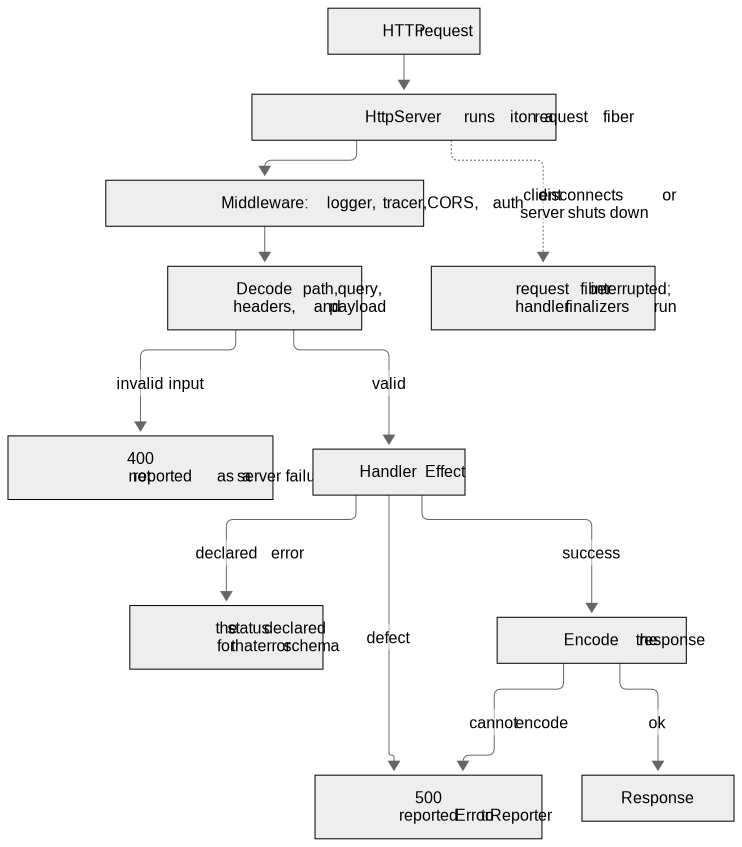
Invalid input fails with 400 before the handler runs and is not a server failure. A declared error uses the status declared for it; a defect or a response that cannot be encoded is a 500 reported to ErrorReporter; a disconnect interrupts the request fiber and runs the handler's finalizers.
HttpApiEndpoint
effect/http-api/HttpApiEndpoint — unstable
One endpoint described as data. HttpApiEndpoint.get(identifier, path, spec) (and post, put, patch, delete, …) declares a route whose params, query, payload, success, and error are all Schemas. The identifier becomes the handler key and client method name and is exposed as .identifier; do not use .name, which is the native function name because endpoints are callable function objects. The path string carries :params.
Mental model. A typed contract: "given these validated inputs, return this success or one of these errors." The verb decides where payload lives — GET uses query string, POST/PUT/PATCH and QUERY use the request body (JSON by default). Path params are strings on the wire; their Schemas must decode from string (use Schema.FiniteFromString, or bridge with Schema.decodeTo to a branded type). Array-valued query fields accept either one value or repeated values, so ?tag=equity decodes like the singleton array form of ?tag=equity&tag=salary.
Fragment · Type-checked with fixture
import { Schema } from "effect"
import { HttpApiEndpoint, HttpApiSchema } from "effect/http-api"
import { CompRecord, EmployeeId, RaiseInput } from "./domain/Comp.ts"
import { EmployeeNotFound } from "./domain/CompErrors.ts"

// GET an employee's comp by id: the path param must DECODE FROM a string.
const getComp = HttpApiEndpoint.get("getComp", "/employees/:id/comp", {
  params: {
    id: Schema.FiniteFromString.pipe(Schema.decodeTo(EmployeeId))
  },
  success: CompRecord,
  // Render this error as a bare 404 with no body.
  error: EmployeeNotFound.pipe(
    HttpApiSchema.asNoContent({ decode: () => new EmployeeNotFound() })
  )
})

// POST a raise: payload is the JSON request body.
const postRaise = HttpApiEndpoint.post("postRaise", "/employees/:id/raise", {
  params: {
    id: Schema.FiniteFromString.pipe(Schema.decodeTo(EmployeeId))
  },
  payload: RaiseInput,
  success: CompRecord
})
HttpApiEndpoint.query declares an HTTP QUERY endpoint: a safe, idempotent read whose payload travels in the request body like a POST, for searches too large or too structured for a query string. The server, the derived client, and HttpApiTest handle it like any other verb; OpenAPI output and CORS need attention, see OpenApi and HttpMiddleware.
Self-contained source · Type-checked
import { Schema } from "effect"
import { HttpApiEndpoint } from "effect/http-api"

// Search comp bands with a structured filter in the body: QUERY /comp-bands/search
const searchBands = HttpApiEndpoint.query("searchBands", "/comp-bands/search", {
  payload: Schema.Struct({
    levels: Schema.Array(Schema.String),
    location: Schema.String
  }),
  success: Schema.Array(Schema.Struct({ level: Schema.String, midpoint: Schema.Finite }))
})
A literal suffix after a path parameter stays literal: /merit-cycles/:id:close binds id and keeps :close as literal path text. The server router, the derived client and urlBuilder, and the OpenAPI path (/merit-cycles/{id}:close) all agree on that shape.
Warning: Put the rule on the contract, not in the handler. A permissive endpoint schema (
id: Schema.String) with the real pattern, range, or brand check repeated inside the handler hides the rule from the derived client, the OpenAPI document, and contract tests, and it lets invalid input reach downstream work before anything rejects it. Put checks and brands onparams,query,headers, andpayload; the handler then only ever sees decoded values. HttpApi answers a request that fails decoding with an empty400and an unmatched requestContent-Typewith415, both before the handler runs — HttpApiTest shows how to prove it. Schema mechanics (checks, brands, transformations) live in Schema.
Reach for it when describing a single route's typed inputs and outputs — the atom every HttpApi is built from.
HttpApiGroup
effect/http-api/HttpApiGroup — unstable
Named bundle of related endpoints sharing a path prefix, middleware, and OpenAPI metadata. HttpApiGroup.make("comp").add(...endpoints) collects endpoints; .prefix("/comp") mounts them; .middleware(Authorization) applies middleware to the group; .annotateMerge(OpenApi.annotations(...)) adds docs. Pass { topLevel: true } to flatten a group's endpoints onto the root of the derived client.
Mental model. The unit of organization and shared policy. In the derived client, a group becomes a namespace (client.comp.getComp()) unless topLevel, in which case methods sit at the root (client.health()).
Fragment · Type-checked with fixture
import { HttpApiEndpoint, HttpApiGroup, HttpApiSchema, OpenApi } from "effect/http-api"
import { Authorization } from "./Authorization.ts"

const getComp = HttpApiEndpoint.get("getComp", "/employees/:id")
const postRaise = HttpApiEndpoint.post("postRaise", "/employees/:id/raise")
const postGrant = HttpApiEndpoint.post("postGrant", "/employees/:id/grants")

// Our CompGroup: read comp, post a raise, record an equity grant.
export class CompGroup extends HttpApiGroup.make("comp")
  .add(getComp, postRaise, postGrant)
  .middleware(Authorization)            // auth for every endpoint in the group
  .prefix("/comp")                      // mount all under /comp
  .annotateMerge(OpenApi.annotations({  // group-level docs
    title: "Compensation",
    description: "Read comp, record raises, and grant equity"
  })) {}

// A top-level group flattens onto the client root: client.health()
export class SystemApi extends HttpApiGroup.make("system", { topLevel: true }).add(
  HttpApiEndpoint.get("health", "/health", { success: HttpApiSchema.NoContent })
) {}
Reach for it when grouping endpoints that share a prefix or auth, or wanting a clean namespace in the generated client.
HttpApi
effect/http-api/HttpApi — unstable
Root value tying groups into one API. HttpApi.make("my-api").add(GroupA).add(GroupB) builds it; .annotateMerge(OpenApi.annotations(...)) adds top-level docs (title, version, license). This single object is what you serve, generate clients from, and produce OpenAPI specs from.
Mental model. Table of contents and source of truth. Everything downstream — server routes, typed client, docs — is derived from it; the contract can't drift.
Fragment · Type-checked with fixture
import { HttpApi, OpenApi } from "effect/http-api"
import { CompGroup } from "./Comp.ts"
import { SystemApi } from "./System.ts"

export class Api extends HttpApi.make("comp-api")
  .add(CompGroup)
  .add(SystemApi)
  .annotateMerge(OpenApi.annotations({ title: "Acme Compensation API" })) {}
HttpApi.ParseOptions sets the Schema parse options (onExcessProperty, errors) that the server and the derived client use for every codec of an endpoint: path, query, headers, payload, success, errors, and SSE events. Annotate the API, a group, or an endpoint with .annotate(HttpApi.ParseOptions, options). The most specific level wins and replaces the whole object (options are not merged), and without an annotation Schema's defaults apply (onExcessProperty: "ignore"). Annotate the API before passing it to HttpApiBuilder.group or HttpApiBuilder.endpoint.
Self-contained source · Type-checked
import { Schema } from "effect"
import { HttpApi, HttpApiEndpoint, HttpApiGroup } from "effect/http-api"

const RaiseInput = Schema.Struct({ amount: Schema.Finite, effectiveDate: Schema.String })

// Reject unknown request fields (a mistyped `efectiveDate` is a 400, not a silent drop)
// and report every issue instead of the first one.
export class RaisesApi extends HttpApi.make("raises").add(
  HttpApiGroup.make("raises").add(
    HttpApiEndpoint.post("propose", "/raises", { payload: RaiseInput })
  )
).annotate(HttpApi.ParseOptions, { onExcessProperty: "error", errors: "all" }) {}
With that annotation a POST carrying an extra property gets 400; without it the property is dropped and the handler runs.
ParseOptions is the fallback for six slot-specific annotations: ParamsParseOptions, QueryParseOptions, HeadersParseOptions, PayloadParseOptions, SuccessParseOptions, and ErrorParseOptions. Each one configures only its slot and, when unset, falls back to ParseOptions. Header codecs receive all request headers, so a blanket onExcessProperty: "error" also rejects undeclared ones such as content-type. Keep strict body parsing while leaving transport headers alone by overriding just that slot:
Self-contained source · Type-checked
import { Schema } from "effect"
import { HttpApi, HttpApiEndpoint, HttpApiGroup } from "effect/http-api"

const RaiseInput = Schema.Struct({ amount: Schema.Finite, effectiveDate: Schema.String })

export class RaisesApi2 extends HttpApi.make("raises").add(
  HttpApiGroup.make("raises").add(
    HttpApiEndpoint.post("propose", "/raises", { payload: RaiseInput })
  )
)
  .annotate(HttpApi.ParseOptions, { onExcessProperty: "error" })
  .annotate(HttpApi.HeadersParseOptions, {}) {}
HttpApi.RedactedNames handles values that are only sometimes secret: query parameters and headers you do not want to model as Redacted, but that must not appear in traces. Annotate the API, a group, or an endpoint with .annotate(HttpApi.RedactedNames, { query?, headers? }). Names are wire names after encoding, matched like Headers.CurrentRedactedNames (strings case-insensitively, regular expressions by test), and a string query name also covers bracketed nested keys such as buildargs[NPM_TOKEN]. For that endpoint they extend UrlParams.CurrentRedactedNames and Headers.CurrentRedactedNames in the HttpApiClient request span and the HttpApiBuilder server span, including failures from middleware and request decoding. The API, group, and endpoint lists are combined; the values sent and decoded are unchanged.
Self-contained source · Type-checked
import { Schema } from "effect"
import { HttpApi, HttpApiEndpoint } from "effect/http-api"

// A signed export link and a delegation header: keep both out of client and server spans.
export const exportPayroll = HttpApiEndpoint.get("exportPayroll", "/payroll/export", {
  query: { signature: Schema.optional(Schema.String) },
  headers: { "x-delegated-for": Schema.optional(Schema.String) }
}).annotate(HttpApi.RedactedNames, {
  query: ["signature"],
  headers: ["x-delegated-for"]
})
Two limits: HttpApi.addHttpApi copies the added API's annotations onto its groups like any other annotation, so a group that sets its own RedactedNames replaces the API's list instead of extending it — repeat the names on the group; and only URL and header span attributes use them, so user_agent.original and span error messages are recorded as is.
Reach for it when assembling groups into the one definition that drives server, client, and docs.
HttpApiSchema
effect/http-api/HttpApiSchema — unstable
Toolkit for describing HTTP-specific facets of a schema: status codes, content types, empty responses, and streaming. HttpApiSchema.status(code) pins a status; NoContent/Created/Accepted are ready-made empty responses; asText({ contentType }) serves a string as text/CSV/etc.; asNoContent({ decode }) turns an error into a bodyless response; asMultipart marks a payload as multipart upload; StreamUint8Array/StreamSse describe streaming bodies (raw bytes or Server-Sent Events).
Mental model. Domain Schemas describe shape; HttpApiSchema annotations describe how that shape rides on HTTP. Pipeable wrappers — MySchema.pipe(HttpApiSchema.status(201)) — bolt HTTP semantics onto a plain Schema without changing its decoded type.
Fragment · Type-checked with fixture
import { Schema } from "effect"
import { HttpApiEndpoint, HttpApiSchema } from "effect/http-api"
import { CompRecord } from "./domain/Comp.ts"

// Content negotiation: the same roster either as JSON OR as a CSV export.
const exportComp = HttpApiEndpoint.get("exportComp", "/export", {
  payload: { departmentId: Schema.String },
  success: [
    Schema.Array(CompRecord),
    Schema.String.pipe(HttpApiSchema.asText({ contentType: "text/csv" }))
  ]
})

// A streamed bytes response with a pinned status and custom content type
// (e.g. a generated comp-band report).
const download = HttpApiEndpoint.get("download", "/report", {
  success: HttpApiSchema.status(206)(
    HttpApiSchema.StreamUint8Array({ contentType: "application/octet-stream" })
  )
})

// Response headers are part of the contract, visible to handlers and clients.
const PaginatedComp = HttpApiSchema.WithHeaders(
  Schema.Array(CompRecord),
  {
    "x-total-count": Schema.FiniteFromString,
    "x-next-page": Schema.optionalKey(Schema.String)
  }
)

const page = HttpApiSchema.withHeaders({
  body: [] as ReadonlyArray<typeof CompRecord.Type>,
  headers: { "x-total-count": 0 }
})
HttpApiSchema.status takes a numeric code or a status literal name from HttpStatus: RaiseInput.pipe(HttpApiSchema.status("Created")) and HttpApiSchema.status(201) annotate the same thing, and the name survives code review better than a bare number.
WithHeaders(bodySchema, headersSchema) makes the success/client value a branded { body, headers } pair and works for streaming success bodies too. For a domain error that should remain the handler's error type while encoding selected fields into HTTP headers, pipe it through encodeToWithHeaders({ body, headers }, { decode, encode }). Nesting WithHeaders is rejected. Explicit content-type or content-length values in the returned headers override values inferred from the body; endpoint construction also rejects ambiguous response variants sharing the same status/content type.
In StreamSse({ data }) mode each event is { id?, event, data }, and data is encoded with the schema's JSON codec before it is stringified, so Schema.Date, Schema.BigInt, or Schema.Option values round-trip through SSE and the OpenAPI document describes their JSON form. The id is optional in the TypeScript type and in the OpenAPI schema, and a decoded event without an id omits the key rather than carrying id: undefined. A custom events schema should declare the id as Schema.optional(Schema.String), not Schema.UndefinedOr(Schema.String). The server writes events through Sse.encoder, which strips CR and LF from id and event values (and NUL from id), so a handler echoing caller-supplied text into them cannot inject extra fields or events; multi-line data is split into data: lines as usual. The event name "effect/http-api/stream/failure" is reserved: it's how a mid-stream handler failure is encoded to the client, and defining your own events schema with that literal fails at endpoint-construction time. StreamSse({ ..., keepAlive: "15 seconds" }) makes the server write a : keepalive comment each time the interval passes while the response is open, stopping when the event stream ends; SSE clients ignore comment lines, so idle connections survive proxies and runtimes that close silent responses.
For code generators and other tooling that inspects declared response schemas (including those from HttpApi.reflect), HttpApiSchema.getResponseEncodingSchema(schema) returns the buffered response encoding (defaulting to JSON, and for WithHeaders preferring the wrapper's encoding), and HttpApiSchema.getEncodeToWithHeadersParts(schema) returns the declared { body, headers } of an encodeToWithHeaders schema, or undefined. They read declarations, not the installed codecs: no-content schemas also report the JSON default (check isNoContent first), streaming and upgrade schemas are outside that contract, and a multipart encoding throws.
StreamUint8Array and StreamNdjson accept one content type or a list (contentType: ["application/x-ndjson", "application/jsonl"]): the first is the default response type, request streams are accepted under every entry, and OpenAPI lists each.
Streaming request payloads
An endpoint can declare HttpApiSchema.StreamUint8Array({ maxBytes? }) or HttpApiSchema.StreamNdjson({ schema, maxBytes?, maxElementBytes? }) as its payload. The handler receives a lazy Stream that reads the body as it pulls (a decoded element stream for NDJSON). A malformed NDJSON line fails the stream with HttpApiSchemaError (400); exceeding maxBytes or maxElementBytes (1 MiB by default) fails it with HttpApiPayloadTooLarge (413), and a content-length over maxBytes is rejected before the handler runs. HttpApiClient sends a Stream payload without buffering it, HttpApiTest passes it through, and OpenApi.fromApi marks the body with x-effect-stream. StreamNdjson also works as a success response.
Self-contained source · Type-checked
import { Schema } from "effect"
import { HttpApiEndpoint, HttpApiSchema } from "effect/http-api"

const Punch = Schema.Struct({ employeeId: Schema.String, at: Schema.String })

// Bulk time-clock import: one JSON object per line, never buffered whole.
export const importPunches = HttpApiEndpoint.post("importPunches", "/punches/import", {
  payload: HttpApiSchema.StreamNdjson({ schema: Punch, maxBytes: "100 MiB" }),
  success: Schema.Struct({ imported: Schema.Number })
})
Upgrades
HttpApiSchema.Upgrade({ protocol, headers? }) declares a raw HTTP/1.1 upgrade (not WebSocket, which it rejects). Requests without matching Connection: Upgrade / Upgrade headers get 426 Upgrade Required before the payload is decoded. The endpoint may declare a buffered payload (not a streaming one), which is read before the 101, and may list ordinary successes next to the upgrade, for a server that declines. The handler receives an upgrade function rather than a socket: upgrade(), or upgrade({ headers }) when headers are declared, which yields the Socket; returning a success value after calling it is a defect. The client returns { headers, socket } for a 101, and HttpApiClient.isUpgraded(result) tells it apart from an ordinary success. The client closes the connection if the 101 headers fail to decode or the call is interrupted while taking it. Bun and Deno servers support only WebSocket upgrades.
Migration: handlers that read socket from the request now call upgrade(). Hand-built HttpApiClient.Upgraded values (for example in client mocks) must include [HttpApiClient.UpgradedTypeId]: HttpApiClient.UpgradedTypeId, and third-party HttpServerRequest implementations must add upgradeWith.
Reach for it when an endpoint needs a specific status, non-JSON content type, empty body, file upload, or streaming response.
HttpApiError
effect/http-api/HttpApiError — unstable
Ready-made schema-typed errors for common HTTP failures: BadRequest, Unauthorized, Forbidden, NotFound, Conflict, UnprocessableEntity (422), RequestTimeout, InternalServerError, and more — each with the correct status code, plus *NoContent variants such as UnprocessableEntityNoContent for empty-body responses. Add to an endpoint's error list and fail with them like any yieldable error.
Mental model. Regular Schema.Error errors — they decode/encode across the wire, and a derived client gets them in its typed error channel automatically. For domain-specific failures, define your own Schema.TaggedError with an httpApiStatus.
Self-contained source · Type-checked
import { Effect } from "effect"
import { HttpApiError } from "effect/http-api"

// Inside a handler: fail with a built-in error like any other.
const handler = Effect.gen(function*() {
  const budgetApproved = false
  if (!budgetApproved) {
    return yield* new HttpApiError.Conflict() // 409
  }
  return "ok"
})
Note: Status codes on your own errors. Define the status on the class:
class EmployeeNotFound extends Schema.TaggedError<EmployeeNotFound>()("EmployeeNotFound", {}, { httpApiStatus: 404 }) {}. The third options argument is where HttpApi reads the code from.
Problem Details (RFC 9457)
Problem Details is opt-in; without it, built-in errors and decode failures produce the same responses as before.
HttpApiError.Problem<Self>()(tag, { type, status, title }, fields?)declares a typed problem as a yieldableSchema.Errorclass rendered, documented, and decoded asapplication/problem+json. Its_tagstays local (Effect.catchTagworks without_tagon the wire); problems that share a status are told apart bytype; extensionfieldsare validated on both sides and cannot replacetype,status, ortitle. Statuses below 500 are not reported to error reporters.HttpApiSchema.asProblem({ title, type? })renders a built-in error such asHttpApiError.NotFoundas a problem (typedefaults toabout:blank).HttpApiMiddleware.ProblemDetails, provided withHttpApiMiddleware.layerProblemDetails({ includeDetails? }), renders request decoding failures as a generic400BadRequestProblem(with per-fielderrorsonly whenincludeDetails: true) and response encoding failures as a500InternalServerErrorProblem, and declares both in OpenAPI and the client.
Self-contained source · Type-checked
import { Effect, Layer, Schema } from "effect"
import {
  HttpApi,
  HttpApiBuilder,
  HttpApiEndpoint,
  HttpApiError,
  HttpApiGroup,
  HttpApiMiddleware,
  HttpApiSchema
} from "effect/http-api"

class BudgetExceeded extends HttpApiError.Problem<BudgetExceeded>()("BudgetExceeded", {
  type: "https://comp.acme.internal/problems/budget-exceeded",
  status: 409,
  title: "The raise exceeds the remaining merit budget."
}, {
  remaining: Schema.Number
}) {}

const Raises = HttpApiGroup.make("raises").add(
  HttpApiEndpoint.post("approve", "/raises/:id/approve", {
    params: { id: Schema.String },
    success: Schema.Struct({ approved: Schema.Boolean }),
    error: [BudgetExceeded, HttpApiError.NotFound.pipe(HttpApiSchema.asProblem({ title: "Raise not found" }))]
  })
)

const Api = HttpApi.make("comp").add(Raises).middleware(HttpApiMiddleware.ProblemDetails)

const RaisesLive = HttpApiBuilder.group(Api, "raises", (handlers) =>
  handlers.handle("approve", () => Effect.fail(new BudgetExceeded({ remaining: 1200 })))
)

export const ApiLive = HttpApiBuilder.layer(Api).pipe(
  Layer.provide(RaisesLive),
  Layer.provide(HttpApiMiddleware.layerProblemDetails())
)
Status mapping is part of the contract
An HTTP status is a claim about what happened. Map every member of the public error union to the status that tells the truth, and let nothing else through.
| Situation | Status | Produced by |
|---|---|---|
| A path, query, header, or payload value fails its Schema, or a JSON body does not parse | 400, empty body (a 400 problem with Problem Details opted in) | HttpApi, before the handler runs |
The request Content-Type matches no declared payload encoding | 415, plain-text body | HttpApi, before the handler runs |
| No route matches | 404, empty body | HttpRouter |
| Credential absent, malformed, expired, or revoked | 401 | your authentication middleware |
| Authenticated, but this actor may not perform this action on this tenant's resource | 403 | your use case or handler |
| The addressed resource does not exist | 404 | a declared error |
| State or idempotency conflict: duplicate key, stale version, raise already approved | 409 | a declared error |
| Well-formed input that current state rejects: salary outside the level's band | 422 | a declared error |
| A response encoding failure — the handler returned a value the declared success or error schema could not encode | 500, empty body | HttpApi — reported to ErrorReporter |
| A defect — anything the endpoint did not declare | 500, empty body | HttpApi — reported to ErrorReporter |
| The request fiber was interrupted: by a client disconnect / by the server itself | 499 / 503 | HttpServerError.causeResponse |
- Only a query that succeeded and returned nothing is "not found". A timeout, an exhausted pool, a permission error, or a malformed row is an infrastructure fault; rendering it as
404or409makes clients act on a lie. Translate storage failures at the repository (SqlError) and let the rest become500. - Do not
Effect.diean expected failure to shrink a union. Convert to a defect only what no caller could act on at this edge — as the handler example does for aBandViolationthat a read cannot produce. ABandViolationthe UI must display belongs in the endpoint'serrorlist. - Request decoding failures are unreported; response encoding failures are not. An invalid path param, query value, header, or payload body fails with
400and the cause is not reported toErrorReporter(it's a client mistake, not a server problem). A handler that returns a value the declared success or error schema cannot encode fails with500and is reported — it is a schema contract violation on the server side. The underlyingHttpApiSchemaErroris preserved as a defect so schema-error middleware (HttpApiMiddleware.layerSchemaErrorTransform) can still inspect it. - Defects are sanitized for you. A defect is answered with a content-free
500; theCausegoes to the server log and any configuredErrorReporter, never to the client. Do not add a catch-all that serializeserror.messageinto the body. - Interruption is not a failure response. A disconnect interrupts the request fiber (
499is for your access log only — nobody receives it); do not catch it, retry it, or count it as an error rate. - The implicit
400is not in the contract until you declare it.OpenApi.fromApilists only declared statuses, and a derived client sees an undeclared400as anHttpClientError. AddHttpApiError.BadRequestNoContenttoerrorwherever inputs are validated; the client then fails with a typedBadRequestand the document lists400. To answer decode failures with your own body instead, implement a middleware withHttpApiMiddleware.layerSchemaErrorTransform(service, (schemaError, { endpoint, group }) => ...). - A public error value is an output surface. Every field of a declared error is serialized to clients and copied into telemetry. Give public errors a stable tag plus safe identifiers; keep
cause, driver messages, SQL text, stack traces, and anythingRedactedon internal errors only.
When a use case fails with a union wider than the endpoint declares, translate it with an exhaustive matcher so that a new member is a compile error rather than a silent 500:
Fragment · Type-checked
import { Data, Effect, Match, Schema } from "effect"

class EmployeeNotFound extends Schema.TaggedError<EmployeeNotFound>()(
  "EmployeeNotFound",
  { employeeId: Schema.String },
  { httpApiStatus: 404 }
) {}

class RaiseAlreadyApproved extends Schema.TaggedError<RaiseAlreadyApproved>()(
  "RaiseAlreadyApproved",
  { raiseId: Schema.String },
  { httpApiStatus: 409 }
) {}

// Internal: carries a driver cause, so it is never declared on an endpoint.
class RepositoryError extends Data.TaggedError("RepositoryError")<{
  readonly operation: string
  readonly cause: unknown
}> {}

type ApproveFailure = EmployeeNotFound | RaiseAlreadyApproved | RepositoryError

// No wildcard branch: adding a member to ApproveFailure stops this from compiling.
const toPublicError = Match.type<ApproveFailure>().pipe(
  Match.tagsExhaustive({
    EmployeeNotFound: (error) => Effect.fail(error),
    RaiseAlreadyApproved: (error) => Effect.fail(error),
    // The HTTP edge is the last owner of an infrastructure fault: a sanitized 500,
    // with the full Cause in the server log.
    RepositoryError: (error) => Effect.die(error)
  })
)

declare const approveRaise: (raiseId: string) => Effect.Effect<void, ApproveFailure>

// Effect<void, EmployeeNotFound | RaiseAlreadyApproved>
export const approveRaiseHandler = (raiseId: string) =>
  approveRaise(raiseId).pipe(Effect.catch(toPublicError))
Reach for it when an endpoint needs a standard HTTP error without hand-rolling the status mapping.
ProblemDetails
effect/http/ProblemDetails — unstable
The RFC 9457 value layer underneath HttpApi's problem support, usable from a plain HttpRouter too. ProblemDetails.contentType is application/problem+json, blankType is about:blank, ProblemDetails.Schema is a lenient codec for a problem object (type, status, title, detail, instance, plus extension members) that follows RFC 9457 when decoding (a missing type becomes about:blank, wrong-typed standard members are dropped, unknown members are kept as extensions), and ProblemDetails.toResponse(problem) builds the application/problem+json response with the problem's status (or 500 when absent).
Self-contained source · Type-checked
import { Effect } from "effect"
import { HttpRouter, ProblemDetails } from "effect/http"

export const MaintenanceRoute = HttpRouter.add("POST", "/payroll/run", () =>
  Effect.succeed(ProblemDetails.toResponse({
    type: "https://comp.acme.internal/problems/maintenance",
    status: 503,
    title: "Payroll runs are paused for maintenance."
  })))
HttpApiSecurity
effect/http-api/HttpApiSecurity — unstable
Declarative security schemes: HttpApiSecurity.bearer (Authorization: Bearer), apiKey({ key, in }) (header/query/cookie), basic (HTTP Basic). Attach to a middleware definition; HttpApi extracts and decodes the credential from each request (handing it to middleware as a Redacted value) and emits the matching securityScheme into the OpenAPI doc so the "Authorize" button works in Swagger/Scalar.
Warning: A security scheme extracts and documents; it verifies nothing. When the header, cookie, or query key is absent or malformed, the middleware still runs and receives an empty credential (
Redacted.make(""), or an emptyusername/passwordforbasic). Rejecting it — and checking signature, expiry, issuer, audience, and revocation — is the middleware's job.
Reach for it when protecting endpoints and wanting both runtime credential extraction and accurate security docs from one declaration.
HttpApiMiddleware
effect/http-api/HttpApiMiddleware — unstable
Middleware for the declarative world, defined as a typed service. HttpApiMiddleware.Service declares what the middleware provides to downstream handlers (e.g. a CurrentUser service), what it requires, the error it can raise, and an optional security scheme. The definition lives next to the API (no implementation); the server supplies a Layer that implements it; clients supply a layerClient to inject credentials.
Mental model. Auth-as-a-service. Because middleware can provide a service, an auth middleware can decode a bearer token and inject the authenticated user into context — downstream handlers just yield* CurrentUser. The provides/requires types are tracked: forgetting to wire a middleware is a compile error, not a runtime failure.
Fragment · Type-checked with fixture
import { Context, Schema } from "effect"
import { HttpApiMiddleware, HttpApiSecurity } from "effect/http-api"
import type { Employee } from "../domain/Comp.ts"

// The service the middleware injects for downstream endpoints — the
// authenticated HRBP/manager driving the comp change.
export class CurrentUser extends Context.Service<CurrentUser, Employee>()(
  "comp/Authorization/CurrentUser"
) {}

export class Unauthorized extends Schema.TaggedError<Unauthorized>()(
  "Unauthorized",
  { message: Schema.String },
  { httpApiStatus: 401 }
) {}

// Definition only — no implementation here.
export class Authorization extends HttpApiMiddleware.Service<Authorization, {
  provides: CurrentUser  // downstream handlers can read CurrentUser
  requires: never
}>()("comp/Authorization", {
  requiredForClient: true,                  // clients must inject credentials too
  security: { bearer: HttpApiSecurity.bearer },
  error: Unauthorized
}) {}
The server implements it as a Layer — validates the credential and provideServices the context:
Fragment · Type-checked with fixture
import { Effect, Layer, Redacted } from "effect"
import { Authorization, CurrentUser, Unauthorized } from "./Authorization.ts"
import { Employee, EmployeeId } from "../domain/Comp.ts"

export const AuthorizationLayer = Layer.effect(
  Authorization,
  Effect.gen(function*() {
    return Authorization.of({
      bearer: Effect.fn(function*(httpEffect, { credential }) {
        if (Redacted.value(credential) !== "hrbp-token") {
          return yield* new Unauthorized({ message: "Invalid bearer token" })
        }
        // Inject the user for every endpoint that runs after this middleware.
        return yield* Effect.provideService(
          httpEffect,
          CurrentUser,
          new Employee({ id: EmployeeId.make(1), name: "Dana HRBP", level: 6, baseSalary: 0 })
        )
      })
    })
  })
)
Authentication is not authorization
The AuthorizationLayer above compares the token with a literal to keep the wiring visible. A real one answers two questions, with two owners and two statuses. Authentication ("who is calling?") belongs to the middleware and fails with 401. Authorization ("may this actor do this, to this resource, in this tenant?") belongs to the use case and fails with 403. Holding a valid token, reaching a route, or appearing in the OpenAPI document authorizes nothing.
| Step | Owner | Rule |
|---|---|---|
| Extract the credential | HttpApiSecurity scheme | Keep it Redacted; call Redacted.value only inside the verifier. |
| Verify it | middleware, through a verifier service | Signature or opaque-token lookup, expiry, issuer/audience, revocation. An empty or invalid credential is one non-revealing 401. |
| Provide a principal | middleware (provides) | A narrow, decoded value — actor id, tenant, permissions — never the raw token or unverified claims. |
| Authorize the operation | use case or handler | Check the concrete actor · action · tenant · resource on every call; fail with a declared 403. |
Self-contained source · Type-checked
import { Context, Effect, Layer, type Redacted, Schema } from "effect"
import { HttpApiMiddleware, HttpApiSecurity } from "effect/http-api"

// What handlers may know about the caller: verified facts only.
export class CurrentPrincipal extends Context.Service<CurrentPrincipal, {
  readonly actorId: string
  readonly tenantId: string
  readonly permissions: ReadonlySet<string>
}>()("comp/CurrentPrincipal") {}

export class Unauthenticated extends Schema.TaggedError<Unauthenticated>()(
  "Unauthenticated",
  {},
  { httpApiStatus: 401 }
) {}

export class Forbidden extends Schema.TaggedError<Forbidden>()(
  "Forbidden",
  {},
  { httpApiStatus: 403 }
) {}

export class Authentication extends HttpApiMiddleware.Service<Authentication, {
  provides: CurrentPrincipal
}>()("comp/Authentication", {
  security: { bearer: HttpApiSecurity.bearer },
  error: Unauthenticated
}) {}

// The verifier is a capability: a JWKS check, a session lookup, or a test fake.
export class TokenVerifier extends Context.Service<TokenVerifier, {
  readonly verify: (
    token: Redacted.Redacted<string>
  ) => Effect.Effect<CurrentPrincipal["Service"], Unauthenticated>
}>()("comp/TokenVerifier") {}

export const AuthenticationLive = Layer.effect(
  Authentication,
  Effect.gen(function*() {
    const verifier = yield* TokenVerifier
    return Authentication.of({
      // A missing header arrives here as an empty credential; the verifier must reject it.
      bearer: Effect.fn(function*(httpEffect, { credential }) {
        const principal = yield* verifier.verify(credential)
        return yield* Effect.provideService(httpEffect, CurrentPrincipal, principal)
      })
    })
  })
)

// Authorization runs per operation, against the resource the request names.
export const authorize = Effect.fn("authorize")(function*(action: string, tenantId: string) {
  const principal = yield* CurrentPrincipal
  if (principal.tenantId !== tenantId || !principal.permissions.has(action)) {
    return yield* new Forbidden()
  }
  return principal
})
A handler for POST /tenants/:tenantId/raises/:id/approve starts with yield* authorize("raise:approve", params.tenantId) and declares Forbidden in the endpoint's error. A request with no Authorization header and an invalid :id gets 401, not 400, because middleware wraps request decoding — an unauthenticated caller learns nothing about your validation rules; a valid token with the wrong tenant or a missing permission gets 403, and the handler body never runs.
- Declare a middleware's error once, on the middleware. It reaches the derived client's error channel and the OpenAPI responses of every endpoint it covers; repeating it on each endpoint is noise.
- Never infer authorization from route possession, a documented security scheme, an unverified claim, a phantom type, or a cast. Audit system actors and "internal" bypass paths the same way as user calls.
- Test every denial independently: no credential, bad credential, wrong tenant, missing permission, and the success path each get their own assertion, plus one that a secret canary appears in neither the response body nor the captured log output.
- If the
401needs aWWW-Authenticatechallenge, fold the header into the error withHttpApiSchema.encodeToWithHeaders(see HttpApiSchema).
Reach for it when you need auth (or any cross-cutting concern) that both decodes credentials and provides typed context to handlers, with wiring checked at compile time.
HttpApiBuilder
effect/http-api/HttpApiBuilder — unstable
The server side — where handlers are implemented. HttpApiBuilder.group(api, "comp", build) gives a typed handlers object whose .handle("name", impl) only accepts endpoints in that group, with inputs (params, query, payload) already decoded and return type constrained to the endpoint's success/error. HttpApiBuilder.layer(api, { openapiPath }) turns the implemented API into router routes (and optionally publishes the OpenAPI JSON).
Mental model. The contract enforcer. You can't implement a nonexistent endpoint, return the wrong type, or omit one — the types prevent it. Inputs arrive validated; focus purely on business logic.
For a larger group, handlers.handleAll({ endpointId: handler, ... }) registers an exhaustively typed identifier-keyed object in one call. It avoids a long fluent chain while preserving the same duplicate/missing-handler checks.
Fragment · Type-checked with fixture
import { Effect, Layer } from "effect"
import { HttpApiBuilder } from "effect/http-api"
import { Api } from "../../api/Api.ts"
import { CurrentUser } from "../../api/Authorization.ts"
import { CompService } from "../CompService.ts"

export const CompApiHandlers = HttpApiBuilder.group(
  Api,
  "comp",
  Effect.fn(function*(handlers) {
    const comp = yield* CompService // your comp/HRIS service

    return handlers
      // Inputs are already decoded: `params`, `payload` are typed.
      .handle("getComp", ({ params }) =>
        // EmployeeNotFound is declared on the endpoint, so let it through;
        // anything unexpected becomes a 500.
        comp.getComp(params.id).pipe(
          Effect.catchTag("BandViolation", Effect.die)
        ))
      .handle("postRaise", Effect.fn(function*({ params, payload }) {
        // BandViolation (salary outside the level's band) is a declared error.
        return yield* comp.recordRaise(params.id, payload)
      }))
      .handle("postGrant", ({ payload }) => comp.recordGrant(payload).pipe(Effect.orDie))
      // The Authorization middleware provided CurrentUser — just read it.
      .handle("me", () => CurrentUser)
  })
).pipe(
  Layer.provide([CompService.layer, AuthorizationLayer])
)
HttpApiBuilder.handler(api, groupId, endpointId, f) defines one endpoint callback outside the group builder. It returns f unchanged, but infers the request shape, the allowed success and error types, and the callback's service requirements from the endpoint — so large groups can keep one handler per module and still register them with handlers.handle.
Fragment · Type-checked
import { Effect, Schema } from "effect"
import { HttpApi, HttpApiBuilder, HttpApiEndpoint, HttpApiGroup } from "effect/http-api"

class CompRecord extends Schema.Class<CompRecord>("CompRecord")({
  employeeId: Schema.String,
  baseSalary: Schema.Finite
}) {}

class Api extends HttpApi.make("comp-api").add(
  HttpApiGroup.make("comp").add(
    HttpApiEndpoint.get("getComp", "/employees/:id/comp", {
      params: { id: Schema.String },
      success: CompRecord
    })
  )
) {}

declare const loadComp: (employeeId: string) => Effect.Effect<CompRecord>

// `params.id` is a string and the result must be a CompRecord — no annotations needed.
export const getComp = HttpApiBuilder.handler(Api, "comp", "getComp", ({ params }) => loadComp(params.id))

export const CompHandlers = HttpApiBuilder.group(Api, "comp", (handlers) => handlers.handle("getComp", getComp))
Assemble the server: provide each group's handler Layer to HttpApiBuilder.layer, mount docs, and serve.
Fragment · Type-checked with fixture
import { NodeHttpServer, NodeRuntime } from "@effect/platform-node"
import { Layer } from "effect"
import { HttpRouter } from "effect/http"
import { HttpApiBuilder, HttpApiScalar } from "effect/http-api"
import { createServer } from "node:http"

const ApiRoutes = HttpApiBuilder.layer(Api, { openapiPath: "/openapi.json" }).pipe(
  Layer.provide([CompApiHandlers, SystemApiHandlers])
)
const DocsRoute = HttpApiScalar.layer(Api, { path: "/docs" })

const ServerLayer = HttpRouter.serve(Layer.mergeAll(ApiRoutes, DocsRoute)).pipe(
  Layer.provide(NodeHttpServer.layer(createServer, { port: 3000 }))
)

Layer.launch(ServerLayer).pipe(NodeRuntime.runMain)
HttpApiBuilder.layer rejects two endpoints with the same method and path, naming both; declare request variants of one operation as a single endpoint with a payload union. An undeclared error that implements HttpServerRespondable renders its own response when error-schema encoding fails (oversized multipart streaming uploads answer 413), while declared error schemas keep precedence.
Handlers are lazy adapters
A handler translates one decoded request into one use-case call and returns the Effect. Keep everything else out.
- Return an Effect; never run one. No
Effect.runPromise, noManagedRuntime, no nested runtime inside a handler — the request fiber must own the work so that a disconnect or shutdown interrupts it (HTTP Server shows the proof). - Depend on use-case services, not infrastructure. A handler that yields
SqlClientor builds anHttpClienthas absorbed persistence and tenancy policy that no other entry point (RPC, CLI, workflow) will share. - Keep public DTOs separate from persistence models. The endpoint's
successschema is a published contract; a table row is not. Map between them in the use case or repository. - Translate errors at this edge, exhaustively (status mapping), and authorize before acting (authentication is not authorization).
Reach for it when implementing the server for an HttpApi — this is the only place handlers live.
HttpApiClient
effect/http-api/HttpApiClient — unstable
Fully typed client derived from your API definition — no codegen. HttpApiClient.make(Api, { transformClient }) produces an object mirroring your groups and endpoints: client.comp.getComp({ params: { id } }) returns Effect<CompRecord, EmployeeNotFound | ...> with request encoding, middleware, and response decoding handled. Path params, query, and payload go under named keys: { params: { id }, payload: { ... } }. transformClient sets the base URL and adds retries by composing the underlying HttpClient.
Mental model. A live, type-level reflection of the server contract. Both sides share the one HttpApi value — renaming an endpoint or tweaking a field breaks client types immediately. If a middleware is requiredForClient, its layerClient must be provided to inject credentials.
Fragment · Type-checked with fixture
import { Context, Effect, flow, Layer, Schedule } from "effect"
import { FetchHttpClient, HttpClient, HttpClientRequest } from "effect/http"
import { HttpApiClient, HttpApiMiddleware } from "effect/http-api"
import { Api } from "./api/Api.ts"
import { Authorization } from "./api/Authorization.ts"

// Client-side implementation of the required Authorization middleware: inject a token.
const AuthorizationClient = HttpApiMiddleware.layerClient(
  Authorization,
  Effect.fn(function*({ next, request }) {
    return yield* next(HttpClientRequest.bearerToken(request, "hrbp-token"))
  })
)

export class ApiClient extends Context.Service<ApiClient, HttpApiClient.ForApi<typeof Api>>()(
  "comp/ApiClient"
) {
  static readonly layer = Layer.effect(
    ApiClient,
    HttpApiClient.make(Api, {
      transformClient: (client) =>
        client.pipe(
          HttpClient.mapRequest(flow(HttpClientRequest.prependUrl("http://localhost:3000"))),
          HttpClient.retryTransient({ schedule: Schedule.exponential(100), times: 3 })
        )
    })
  ).pipe(
    Layer.provide(AuthorizationClient),   // required because requiredForClient: true
    Layer.provide(FetchHttpClient.layer)  // the underlying HttpClient implementation
  )
}

// Calling it is just Effect. Types mirror the API end-to-end.
export const callApi = Effect.gen(function*() {
  const client = yield* ApiClient
  // Path params live under `params`; the result is typed CompRecord.
  const comp = yield* client.comp.getComp({ params: { id: 42 } })
  yield* client.health() // SystemApi was topLevel -> method sits at the root
  return comp
}).pipe(Effect.provide(ApiClient.layer))
Options and per-call controls worth knowing:
| Need | Use |
|---|---|
| Point the client at a host or base path | HttpApiClient.make(Api, { baseUrl: "https://hr.acme.internal/api/v2" }) — shorter than a prependUrl transform |
| The status or headers as well as the decoded value | pass responseMode: "decoded-and-response" (a [value, response] tuple) or "response-only" in the call's request object; the default is "decoded-only" |
| A link or redirect target without executing a request | HttpApiClient.urlBuilder(Api, { baseUrl }) mirrors the client's shape and returns strings: urls.comp.getComp({ params, query }). Params and query are encoded through the endpoint schemas, and a base URL's pathname is kept |
| Stricter or exhaustive decoding of responses | the same HttpApi.ParseOptions annotation (or its per-slot variants) the server reads also configures the client's request encoders and response decoders |
Decode a raw response later, for example after responseMode: "response-only" | HttpApiClient.decodeResponse(Api, { group, endpoint }) builds a reusable decoder that applies the endpoint's declared success and error schemas (undeclared statuses fail with a DecodeError described as undeclared status code); build it once and run it inside the scope that owns the response |
A larger SSE event budget for one StreamSse endpoint | sseOptions: { maxEventSize } in that call's request object; the default cap is 10 MiB per pending event |
The client decodes JSON, text, bytes, and form-urlencoded responses according to the endpoint's declared encoding. Request values are encoded through the endpoint schemas before anything is sent, so a value that violates a check fails locally with SchemaError: a typed client cannot produce malformed wire input, which is why boundary tests need a raw request (HttpApiTest).
Path parameters equal to . or .. are rejected so they cannot rewrite the request path through URL normalization, and path-parameter regex constraints are not emitted into client URLs or OpenAPI paths.
Reach for it when consuming an HttpApi from another service or frontend and wanting a typed client that can never silently drift from the server.
OpenApi
effect/http-api/OpenApi — unstable
OpenAPI 3.1 generator and annotation toolkit. OpenApi.fromApi(api) returns a complete spec object derived from endpoints, schemas, errors, and security. OpenApi.annotations({ title, version, description, license, ... }) attaches metadata; services (OpenApi.Title, Version, Servers, Summary, Deprecated, Exclude, Transform) override anything down to a single parameter. When several security middlewares are stacked on an endpoint, the document requires all of them (one combined security requirement), matching the server; optional parameters and headers are not marked nullable, and includeAnnotationKey copies selected custom schema annotations (such as x-* vendor extensions) into the output.
Mental model. Docs are a projection of the same definition — not a parallel artifact kept in sync by hand. Because the spec comes from live Schemas, request/response shapes in the docs are always correct. Results are fresh clones even when the compiler cache is hit, so mutating one returned spec does not contaminate a later fromApi call.
Fragment · Type-checked with fixture
import { OpenApi } from "effect/http-api"
import { Api } from "./api/Api.ts"

// The raw spec object — serve it, write it to a file, feed it to codegen tools.
const spec = OpenApi.fromApi(Api)
Typically you don't call fromApi yourself — passing openapiPath to HttpApiBuilder.layer publishes it, and Swagger/Scalar layers consume it. Annotate at any level: HttpApi.make(...).annotateMerge(OpenApi.annotations({ title, version })) for the whole API, or equivalently on a group or endpoint.
Facts that decide how you use the document:
- Each model owns its own artifact. A value Schema knows a shape, so
Schema.toJsonSchemaDocumentyields a JSON Schema for config validation, structured-output prompts, or cross-language payload codegen. Methods, paths, parameter locations, statuses, per-endpoint errors, security, and media types live only on the assembledHttpApi, so the OpenAPI document must come fromOpenApi.fromApi. Feeding either generator the other model produces a document missing exactly the facts the other owns — and a JSON Schema is not "the OpenAPI". - Objects are closed here, open there.
fromApigenerates object schemas withonExcessProperty: "error", so struct bodies carryadditionalProperties: false. A bareSchema.toJsonSchemaDocumentcall leaves objects open (additionalProperties: true) unless you pass the same option. Decoding is a separate matter: by default the server decodes with Schema's default parse options, so an unknown request property is dropped before the handler sees the payload, not rejected. To make the server enforce what the document advertises, annotate the API withHttpApi.ParseOptions{ onExcessProperty: "error" }. QUERYoperations sit under an extension. OpenAPI 3.1 has noqueryfield, sofromApiemits anHttpApiEndpoint.queryoperation underpaths[path]["x-oai-additionalOperations"].QUERY. Swagger UI, Scalar, and generators that do not read that extension will not show it;@effect/openapi-generatorreads both the extension and OpenAPI 3.2's nativequeryfield.- Only identified schemas become components. A schema with an
identifierannotation is emitted once undercomponents.schemasand referenced by$ref; anonymous structs are inlined at each use. ASchema.ClassnamedCompRecordappears asCompRecordEncoded, because the document describes the encoded side. Name the DTOs you want codegen tools to reuse. - Optionality mirrors the encoded schema. A path parameter, query parameter, or response header is marked optional in the document precisely when the corresponding field is optional on the schema's encoded side (
Schema.optional, etc.) — the same flag that decoding uses, so the document never drifts from runtime behavior. - Generation is deferred. The
openapiPath, Swagger, and Scalar routes build the document on the first request and memoize it, so startup stays cheap — and a generation defect (duplicateoperationId, conflicting security scheme, invalid component key) surfaces on that first request, not at boot. CallOpenApi.fromApi(Api)in a test to move the failure into CI. - Overrides apply last. Endpoint-level
OpenApi.OverrideandOpenApi.Transformannotations run after schema generation, so a transform sees — and may rewrite — the finished operation, including its generated request and response schemas. - Assert semantics, not snapshots. Check the facts a consumer depends on — path, method, parameter locations, security requirement, media types, each declared status — instead of snapshotting the whole document, whose key order and component layout are not a contract.
Official guide: Schema to JSON Schema — how identifier annotations become shared definitions (its "Generation Options" section describes an additionalProperties option; HttpApi uses onExcessProperty instead).
Reach for it when you need an OpenAPI document for external consumers, codegen, or API gateways — guaranteed to match what you actually serve.
HttpApiSwagger
effect/http-api/HttpApiSwagger — unstable
Mounts Swagger UI for your API. HttpApiSwagger.layer(Api, { path: "/docs" }) serves the interactive Swagger explorer (with a working "Authorize" button if security is declared) at the chosen path, backed by the generated OpenAPI spec. Merge the Layer alongside your API routes.
Fragment · Type-checked with fixture
import { HttpApiSwagger } from "effect/http-api"
import { Api } from "./api/Api.ts"

const SwaggerRoute = HttpApiSwagger.layer(Api, { path: "/docs" })
Reach for it when you want the familiar Swagger UI with zero extra wiring.
HttpApiScalar
effect/http-api/HttpApiScalar — unstable
Same idea as Swagger, rendered with Scalar's modern API reference UI. HttpApiScalar.layer(Api, { path: "/docs" }) bundles the Scalar script inline; HttpApiScalar.layerCdn(Api, { path, version }) loads it from a CDN. Both serve the generated OpenAPI spec.
Scalar configuration supports authentication.preferredSecurityScheme (a scheme name, alternatives, nested combinations, or null) to choose the initially selected authentication UI. It changes the explorer's preference, not the API's security requirements or the server's credential verification.
Fragment · Type-checked with fixture
import { HttpApiScalar } from "effect/http-api"
import { Api } from "./api/Api.ts"

const DocsRoute = HttpApiScalar.layer(Api, { path: "/docs" })
Reach for it when you want a modern docs page instead of Swagger UI — same effort, nicer result.
HttpApiTest
effect/http-api/HttpApiTest — unstable
In-memory testing — no socket, no port. HttpApiTest.groups(Api, ["comp"]) wires selected groups' handlers to a generated client through the real request encoding, routing, response encoding, and client decoding pipeline, then returns the typed client. Call endpoints exactly as in production and assert on results. Unselected groups get placeholder handlers that fail if called, keeping tests scoped.
Mental model. Full HttpApi round-trip with the network removed — exercises schema validation, status mapping, and middleware for real, while staying fast and deterministic.
Fragment · Type-checked with fixture
import { assert, it } from "@effect/vitest"
import { Effect, FileSystem, Layer, Path } from "effect"
import { Etag, HttpPlatform } from "effect/http"
import { HttpApiTest } from "effect/http-api"
import { Api } from "./api/Api.ts"
import { CompApiHandlers } from "./server/Comp/http.ts"

// HttpApiBuilder needs these platform services; FileSystem can be a noop in tests.
const TestServices = Layer.mergeAll(Path.layer, Etag.layerWeak, HttpPlatform.layer).pipe(
  Layer.provideMerge(FileSystem.layerNoop({}))
)

it.layer(TestServices)("Comp API", (it) => {
  it.effect("reads an employee's comp", () =>
    Effect.gen(function*() {
      const client = yield* HttpApiTest.groups(Api, ["comp"]).pipe(
        Effect.provide(CompApiHandlers)
      )
      const comp = yield* client.comp.getComp({ params: { id: 1 } })
      assert.strictEqual(comp.employeeId, 1)
    }))
})
HttpServer.layerServices is the ready-made equivalent of the TestServices Layer above (Path, a weak Etag generator, HttpPlatform, and a no-op FileSystem). The harness also runs registered pre-response handlers, so headers and cookies added with HttpEffect.appendPreResponseHandler or HttpApiBuilder.securitySetCookie are visible on the test response.
What each test ring proves
| Ring | Drive it with | Proves | Does not prove |
|---|---|---|---|
| 1. Compile | tsc over the API, the complete handler Layers, the derived client, and the root Layer | the contract, handlers, and wiring agree | any runtime behavior |
| 2. Document | targeted assertions on OpenApi.fromApi(Api) | published paths, parameters, security, media types, and statuses | that the server behaves that way |
| 3. In process | HttpApiTest.groups | codecs, routing, middleware, status mapping, typed errors | malformed input (the typed client cannot send it), sockets, disconnects |
| 4. Raw wire | HttpRouter.toWebHandler with a hand-built Request, or a real listener on port 0 | malformed JSON, wrong Content-Type, bad headers, invalid params, streaming, disconnect, listener release | that the deployed artifact starts |
| 5. Artifact | the built bundle or container, launched as in production | packaging, config, and startup | — |
A direct call to a service method is evidence about that service, not about HTTP. To show where validation lives, send an invalid value over the raw wire and assert both the 400 and that the dependency behind the handler was never touched:
Self-contained source · Type-checked
import { assert, it } from "@effect/vitest"
import { Context, Effect, Layer, Ref, Schema } from "effect"
import { HttpRouter, HttpServer } from "effect/http"
import { HttpApi, HttpApiBuilder, HttpApiEndpoint, HttpApiGroup } from "effect/http-api"

const EmployeeId = Schema.String.check(Schema.isPattern(/^E-\d{4}$/)).pipe(Schema.brand("EmployeeId"))
const CompRecord = Schema.Struct({ employeeId: EmployeeId, baseSalary: Schema.Finite })

class Api extends HttpApi.make("comp-api").add(
  HttpApiGroup.make("comp").add(
    HttpApiEndpoint.get("getComp", "/employees/:id/comp", {
      params: { id: EmployeeId }, // the rule lives on the contract
      success: CompRecord
    })
  )
) {}

class CompRepository extends Context.Service<CompRepository, {
  readonly find: (id: typeof EmployeeId.Type) => Effect.Effect<typeof CompRecord.Type>
}>()("comp/CompRepository") {}

const CompHandlers = HttpApiBuilder.group(
  Api,
  "comp",
  Effect.fn(function*(handlers) {
    const repository = yield* CompRepository
    return handlers.handle("getComp", ({ params }) => repository.find(params.id))
  })
)

it.effect("an invalid id never reaches the repository", () =>
  Effect.gen(function*() {
    const calls = yield* Ref.make(0)
    const CountingRepository = Layer.succeed(CompRepository)({
      find: (employeeId) =>
        Ref.update(calls, (n) => n + 1).pipe(Effect.as({ employeeId, baseSalary: 180_000 }))
    })
    const Routes = HttpApiBuilder.layer(Api).pipe(
      Layer.provide(CompHandlers),
      Layer.provide(CountingRepository),
      Layer.provide(HttpServer.layerServices)
    )
    // The typed client would reject "nope" while encoding, so speak raw HTTP instead.
    const { dispose, handler } = HttpRouter.toWebHandler(Routes, { disableLogger: true })
    yield* Effect.addFinalizer(() => Effect.promise(dispose))

    const invalid = yield* Effect.promise(() => handler(new Request("http://localhost/employees/nope/comp")))
    assert.strictEqual(invalid.status, 400)
    assert.strictEqual(yield* Ref.get(calls), 0) // validation happened before the handler

    const valid = yield* Effect.promise(() => handler(new Request("http://localhost/employees/E-0042/comp")))
    assert.strictEqual(valid.status, 200)
    assert.strictEqual(yield* Ref.get(calls), 1)
  }))
For a secured mutation, cover every declared status, and the tenant and permission denials independently; assert over the raw wire that a defect yields a content-free 500 (inside HttpApiTest a handler defect surfaces as a defect of the client call, so the rendered response is not visible there); and plant a canary secret to confirm it reaches neither the response body nor the captured log output.
Reach for it when testing handlers, schema round-trips, error mapping, or middleware — fast, faithful, without standing up a server.
Tip: Full arc: define endpoints with
HttpApiEndpoint, bundle withHttpApiGroup, assemble withHttpApi; annotate HTTP facets withHttpApiSchemaand errors withHttpApiError/HttpApiSecurity/HttpApiMiddleware; implement on the server withHttpApiBuilderand serve viaHttpRouter; consume with the derivedHttpApiClient; publish docs withOpenApi+HttpApiSwagger/HttpApiScalar; test in memory withHttpApiTest. One definition — every consumer in lockstep.