Fibers, Scopes & Runtimes
What happens after you build an Effect: how it finishes (Exit and its full Cause), the fibers that run it and the handles that supervise them, the Scope that bounds every resource, the scheduler and clock underneath, the one-shot and gate primitives fibers coordinate with, and the runtimes that run Effects from non-Effect code. Core Runtime & Execution covers building and combining Effects; this page covers owning them while they run.
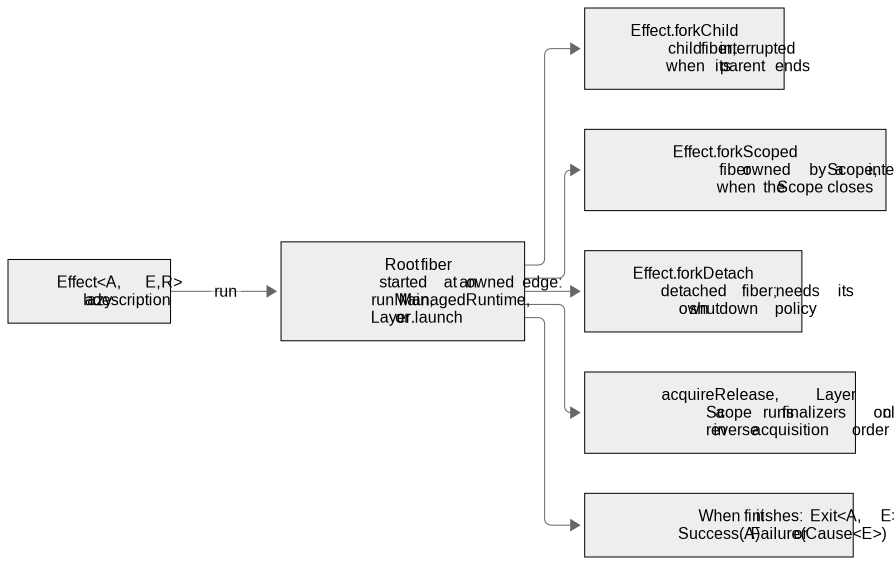
An Effect is only a description until an owned edge runs it on a root fiber. Every fiber it forks has an owner that ends it, every resource is released by the Scope that acquired it, and the run ends in an Exit carrying the full Cause.
Exit
effect/Exit — stable
Exit<A, E> is the result of a finished computation: either Success<A> (holding the value) or Failure<A, E> (holding a Cause<E>). Returned by runSyncExit, runPromiseExit, Fiber.await, and finalizers. An Exit is itself an Effect, so you can yield* it to re-raise its result. Pattern-match with Exit.match, or guard with isSuccess / isFailure.
Self-contained source · Type-checked
import { Cause, Effect, Exit, Fiber } from "effect"

const program = Effect.gen(function*() {
  // Run a per-employee review task and capture its outcome as data
  // instead of letting a single failure propagate.
  const fiber = yield* Effect.forkChild(Effect.fail("hris timeout"))
  const exit = yield* Fiber.await(fiber) // Exit<never, string>, never fails
  return exit
})

// Branch on a finished review result.
const describe = (exit: Exit.Exit<number, string>) =>
  Exit.match(exit, {
    onSuccess: (raise) => `approved raise: ${raise}`,
    // onFailure receives the *Cause*, not a bare error.
    onFailure: (cause) => `review failed: ${Cause.pretty(cause)}`
  })
Note: Use
Effect.catchfor error handling within effects. UseExitat boundaries where a computation has already finished and you need to inspect the result as a value: awaiting a fiber, reading a finalizer's exit, or running at the app edge withrunSyncExit.
Inside an effect, Effect.exit(self) captures the complete outcome — typed failure, defect, and interruption — as a value with E = never; Effect.result captures only the typed failure. Construct exits with Exit.succeed, Exit.fail, Exit.die, Exit.interrupt, and Exit.failCause(cause); classify them with Exit.hasFails / Exit.hasDies / Exit.hasInterrupts — plain boolean checks, like their Cause counterparts, so a false does not narrow the exit; narrow with Exit.isSuccess / Exit.isFailure — and pull the first typed error out with Exit.findErrorOption. Test assertions should match on this structure, never on rendered failure text.
Official guides: Exit, Unexpected Errors.
Reach for it when you've crossed out of the Effect world and need to inspect success-or-cause synchronously.
Cause
effect/Cause — stable
The complete, structured record of why an effect failed. A single failure can be several things simultaneously — a typed error, a finalizer that threw, and an interruption. Cause retains all of them. A Cause is a flat array of reasons. There are exactly three reason kinds: Fail (typed error), Die (unexpected defect), and Interrupt (fiber cancelled). An empty cause is an empty array.
Self-contained source · Type-checked
import type { Cause } from "effect"

type CauseShape<E> = {
  readonly reasons: ReadonlyArray<Cause.Reason<E>>
}
// Cause.Reason<E> = Cause.Fail<E> | Cause.Die | Cause.Interrupt
Because it's flat, inspection is a loop, not a recursion. Narrow each reason with is*Reason guards; query whole-cause with hasFails / hasDies / hasInterrupts.
Fragment · Type-checked
import { Cause } from "effect"

const summarize = (cause: Cause.Cause<string>): string => {
  for (const reason of cause.reasons) {
    if (Cause.isFailReason(reason)) return `comp error: ${reason.error}`
    if (Cause.isDieReason(reason)) return `defect: ${String(reason.defect)}`
    if (Cause.isInterruptReason(reason)) return `cycle interrupted by ${reason.fiberId}`
  }
  return "empty cause"
}

// Whole-cause predicates avoid hand-rolling the loop.
declare const cause: Cause.Cause<string>
const wasCancelledCleanly = Cause.hasInterruptsOnly(cause)
const allFails = cause.reasons.filter(Cause.isFailReason)
When a Cause holds more than one reason. Reasons accumulate where outcomes combine: a failing use plus a failing finalizer (section 10 of Core Runtime & Execution), every contender of a race that nobody won, or an explicit Cause.combine(a, b). A fail-fast Effect.all or Effect.forEach is not such a place — it records the first failure only, so later members' failures never appear in reasons; accumulate with { mode: "result" }, Effect.partition, or Effect.validate instead.
Constructing and re-raising. Build causes with Cause.fail(error), Cause.die(defect), Cause.interrupt(fiberId?), and Cause.combine; fail with one through Effect.failCause(cause) (a die-only or interrupt-only cause leaves E = never). After Effect.catchCause, propagate what you cannot handle with Effect.failCause(cause) unchanged — Effect.fail(Cause.squash(cause)) collapses the record to a single value. Interrupt.fiberId is number | undefined.
Rendering. Cause.pretty(cause) is for humans: an empty cause renders as the empty string, a non-Error failure is wrapped as Error: <value>, and a combined cause renders one block per reason. Cause.prettyErrors(cause) returns the per-reason Error objects for a reporter. Both are diagnostics that change between releases — never assert on them.
Official guides: Cause, Parallel and Sequential Errors, Sandboxing.
Reach for it when you need to distinguish a typed error from a defect from an interruption, inspect every reason when outcomes combine, or render a full diagnostic with Cause.pretty.
Recovering from a mixed Cause
The typed recovery operators — Effect.catch, catchTag / catchTags, catchIf, Effect.match, Effect.result, Effect.retry, and Effect.orDie — look up the first Fail reason in the flat cause, with one rule first: a defect takes precedence. If the cause holds any Die, they do not recover; they turn every typed error into a defect and propagate it. If there is no Fail, the cause passes through untouched. An interruption beside a Fail does not block recovery, and is dropped when the handler's result replaces the outcome. Effect.mapError is not recovery: it maps every typed error in place and keeps all other reasons.
| Input cause | Effect.catch(() => fallback) | Effect.orDie | Guarded catchCause (below) |
|---|---|---|---|
Die only | unchanged — still a defect | unchanged | unchanged |
Fail only | success with the fallback | Die(error) | success with the fallback |
Fail + Die | Die(error) + Die(defect) — the handler does not run | Die(error) + Die(defect) | unchanged — both reasons kept |
Fail + Interrupt | success — the interruption is lost | Die(error) — the interruption is lost | unchanged — both reasons kept |
two Fail reasons | the handler sees only the first | Die(first) | success with the fallback |
The runtime applies the same precedence when it combines outcomes itself: a typed failure followed by a dying finalizer, or a failing fiber whose interrupted sibling dies during cleanup, already yields [Die(error), Die(defect)].
So: where an interruption or a second typed failure recorded alongside matters, recover through Effect.catchCause with an explicit guard; recover from a defect only deliberately, with Effect.catchDefect or catchCause; and never use Effect.orDie as a way to tidy an error union. Effect.tapError and the finalizer family observe without replacing, so they are safe.
Self-contained source · Type-checked
import { Cause, Effect } from "effect"

// Recover the expected failure only when nothing else went wrong alongside it.
const recoverCleanFailure = <A, E, R>(self: Effect.Effect<A, E, R>, fallback: A) =>
  self.pipe(
    Effect.catchCause((cause) =>
      Cause.hasDies(cause) || Cause.hasInterrupts(cause)
        ? Effect.failCause(cause) // not ours to handle: propagate every reason
        : Effect.succeed(fallback)
    )
  )
Effect.sandbox(self) is the other route: it moves the whole Cause<E> into the error channel so ordinary typed combinators (catch, mapError, result) see it. There is no unsandbox; restore the normal model with Effect.catch(Effect.failCause). For a single recovery step catchCause is simpler. The operator-by-operator treatment is in Errors, Option & Result.
Fiber
effect/Fiber — stable
Fiber<A, E> is a lightweight green thread — a running or finished execution of an effect. You don't construct one directly; you get a handle from Effect.forkChild (and friends). A child fiber is bound to its parent's lifetime: when the parent ends, the child is interrupted — no leaks. Fiber.await gives you the Exit (never fails); Fiber.join propagates the result into the current effect (fails if the fiber failed); Fiber.interrupt cancels it and waits for cleanup.
Self-contained source · Type-checked
import { Effect, Fiber } from "effect"

const program = Effect.gen(function*() {
  // forkChild: a supervised child that recomputes one employee's vested equity.
  const valuation = yield* Effect.forkChild(
    Effect.gen(function*() {
      yield* Effect.sleep("1 second")
      return 4_250 // vested shares as of today
    })
  )

  // join propagates success/failure into this fiber...
  const vested = yield* Fiber.join(valuation)
  // ...whereas await would hand back the Exit without failing.
  return vested
})
A fork returns a handle, not a result, and a Fiber is not yieldable — yield* fiber does not compile. Turn handles back into effects and then use ordinary combinators: Fiber.join for one, Fiber.joinAll(fibers) for an array of results, Fiber.awaitAll(fibers) for an array of exits, Fiber.interruptAll(fibers) to cancel a group. Low-level integrations that read a fiber's derived state use fiber.cache (scheduler, span, logLevel, minimumLogLevel, maxOpsBeforeYield, ...); there is no separate family of current* fields. Once a fiber exits, its cache.span and cache.stackFrame are cleared, so a finished fiber held by a cache entry, an observer, or a Deferred does not keep its last span and that span's parents alive.
Official guide: Fibers (its prose calls Effect.yieldNow(); Effect.yieldNow is a value, not a function, and the guide does not mention startImmediately).
Reach for it when you need manual control over a background task — fork work, keep the handle, and await or interrupt on your own schedule. For fixed bundles of work, prefer Effect.all/forEach with { concurrency }.
Choosing a fork by its owner
Name the owner first; the fork function follows. The four fork functions differ only in who is responsible for interrupting the fiber.
| Function | Owner | Interrupted when | Choose when | Avoid when |
|---|---|---|---|---|
Effect.forkChild(effect) | the current fiber | the parent ends — success, failure, or interruption — and the child's finalizers run | the work must not outlive the code that started it: a helper for this request or this batch | the work has to survive the function that forked it |
Effect.forkScoped(effect) (adds Scope to R) | the surrounding Scope | that scope closes | background work owned by a Layer, a request scope, or a test | the nearest scope closes too early — wrapping the fork itself in Effect.scoped interrupts it at once |
Effect.forkIn(effect, scope) | a Scope you were handed, or captured with Effect.scope | that scope closes | "start it here, own it there" — forked inside an inner scope but owned by an outer one | the current scope is already the right owner |
Effect.forkDetach(effect) | nobody — the global scope | never, unless someone keeps the handle and interrupts it | process-lifetime work with a documented stop path | library and domain code. If nobody can say who interrupts a detached fiber, it is a leak. |
Two corollaries: a long-lived loop should be exposed as an effect and run in the caller's fiber or scope rather than forked internally, and reusable code should not create root fibers. All four functions accept { startImmediately, uninterruptible }. Forking into a scope that has already closed (forkScoped or forkIn) never runs the effect, even with those options: it returns an already-interrupted fiber. For dynamic populations of fibers use FiberHandle, FiberMap, or FiberSet instead of hand-kept handles; the worked example is Structured Concurrency Through a Bounded Worker.
Fragment · Type-checked
import { Effect } from "effect"

declare const heartbeat: Effect.Effect<never>
declare const pollApprovals: Effect.Effect<never>

const meritCycleServer = Effect.scoped(Effect.gen(function*() {
  const cycleScope = yield* Effect.scope
  yield* Effect.scoped(Effect.gen(function*() {
    yield* Effect.forkIn(heartbeat, cycleScope) // owned by the outer scope
    yield* Effect.forkScoped(pollApprovals)      // owned by this inner scope
  }))
  // pollApprovals is already interrupted here; heartbeat runs until the outer scope closes.
}))
When a forked fiber starts
Forking returns the handle immediately; the child is only scheduled and does not run until the current fiber yields or suspends. Code that forks a listener — a PubSub or SubscriptionRef.changes consumer, a queue taker, a latch waiter — and then publishes straight away can therefore lose the first events. Letting the parent yield (yield* Effect.yieldNow, a value, not a function) usually helps but is not a hard ordering guarantee. When the child must register before the parent continues, pass { startImmediately: true }: the child runs synchronously up to its first suspension before the fork returns. The same option removes "has it started yet?" guesses from tests.
Self-contained source · Type-checked
import { Effect, Fiber, Ref } from "effect"

const program = Effect.gen(function*() {
  const events = yield* Ref.make<ReadonlyArray<string>>([])
  const record = (event: string) => Ref.update(events, (all) => [...all, event])

  const lazyListener = yield* Effect.forkChild(record("listener registered"))
  yield* record("first approval published") // runs first: the child is only scheduled so far
  yield* Fiber.join(lazyListener)

  const eagerListener = yield* Effect.forkChild(record("eager listener registered"), {
    startImmediately: true
  })
  yield* record("second approval published") // runs after the eager child registered
  yield* Fiber.join(eagerListener)

  return yield* Ref.get(events)
})
// ["first approval published", "listener registered",
//  "eager listener registered", "second approval published"]
Requesting cancellation versus awaiting cleanup
Fiber.interrupt(fiber) completes only after the target has finished — finalizers included — so it back-pressures the caller, and a slow finalizer makes a slow cancel. A fiber inside an uninterruptible region or a finalizer keeps running until that region ends. If the region then fails, the pending interruption still wins: recovery handlers such as Effect.catch are skipped, the typed failure is dropped from the Cause, and the fiber exits interrupted (defects are kept). When the caller must not wait (inside a request handler, under its own deadline), signal and move on: Effect.forkChild(Fiber.interrupt(fiber), { startImmediately: true }) sends the interruption before continuing while cleanup proceeds in the background, and fiber.interruptUnsafe() is the synchronous hook that platform runMain uses for SIGINT. A public "cancel" API should say which of the two it offers: request cancellation or await cleanup.
FiberHandle
effect/FiberHandle — stable
A scoped holder for at most one fiber. Setting a new fiber interrupts the previous one (unless onlyIfMissing is passed); closing the owning scope interrupts the current fiber automatically, and also waits for replaced fibers that are still running their interruption cleanup. "Latest wins." The structured-concurrency answer to the let current; current?.cancel(); current = start() pattern.
Fragment · Type-checked
import { Effect, FiberHandle } from "effect"

// Recompute the merit-budget pool whenever a recommendation changes.
declare const recomputeBudget: Effect.Effect<void>

const makeBudgetRecomputer = Effect.gen(function*() {
  const handle = yield* FiberHandle.make<void>()

  // Each edit replaces the in-flight recompute — the older one is interrupted.
  const trigger = FiberHandle.run(handle, recomputeBudget)

  yield* trigger
  yield* trigger // first recompute cancelled, second takes over
}).pipe(Effect.scoped) // closing the scope interrupts whatever is running
Reach for it when exactly one instance of a task should be alive at a time and re-triggering should cancel the old one.
FiberMap
effect/FiberMap — stable
A scoped map of fibers keyed by some value. Running work under a key replaces any existing fiber for that key (or skips with onlyIfMissing). Completed fibers remove themselves; closing the scope interrupts all remaining fibers, including replaced ones whose interruption cleanup is still running, and waits for them. FiberHandle generalized from one slot to many, with the same leak-proof guarantee.
Fragment · Type-checked
import { Effect, FiberMap } from "effect"

// Run one supervised review task per employee, keyed by employee id.
declare const runReview: (employeeId: string) => Effect.Effect<void>

const meritCycle = Effect.gen(function*() {
  const reviews = yield* FiberMap.make<string>()

  // One supervised fiber per employee.
  yield* FiberMap.run(reviews, "emp_142", runReview("emp_142"))
  yield* FiberMap.run(reviews, "emp_207", runReview("emp_207"))

  // Idempotent start: don't restart a review that's already running.
  yield* FiberMap.run(reviews, "emp_142", runReview("emp_142"), {
    onlyIfMissing: true
  })

  const inFlight = yield* FiberMap.size(reviews)
  return inFlight
}).pipe(Effect.scoped) // every review fiber is interrupted on shutdown
Reach for it when you have a dynamic population of keyed background fibers and want them all interrupted cleanly when the parent scope closes.
FiberSet
effect/FiberSet — stable
A scoped, unkeyed bag of fibers. Added fibers remove themselves on completion; closing the scope interrupts whatever remains. FiberSet.awaitEmpty blocks until the set drains. The keyless sibling of FiberMap — use when spawning an unbounded stream of fire-and-forget tasks that need group supervision.
Fragment · Type-checked
import { Effect, FiberSet } from "effect"

// Fan out one fiber per raise-approved notification, then wait for the batch.
declare const notifyManager: (raise: unknown) => Effect.Effect<void>
declare const approvedRaises: ReadonlyArray<unknown>

const sendApprovals = Effect.gen(function*() {
  const fibers = yield* FiberSet.make<void>()

  for (const raise of approvedRaises) {
    yield* FiberSet.run(fibers, notifyManager(raise)) // fire-and-supervise
  }

  yield* FiberSet.awaitEmpty(fibers) // wait for every notification to finish
}).pipe(Effect.scoped)
Official guide: Tracking Fibers (uses FiberSet.size as a live "fibers in flight" gauge).
Reach for it when you spawn many independent throwaway fibers and want them tracked as a group — interrupted together on scope close, or awaited together with awaitEmpty.
Runtime
effect/Runtime — stable
Process-lifecycle helpers: makeRunMain (used by platform packages to build runMain), Teardown / defaultTeardown (turn an Exit into a process exit code), error markers for custom exit codes, and the InterruptExitCode annotation for interruptions that end the program on purpose. Application code almost never imports this directly — use NodeRuntime.runMain / BunRuntime.runMain, which are built on makeRunMain. Touch it only to customize how completion maps to an exit code.
Fragment · Type-checked
import { Effect, Exit, Runtime } from "effect"

// A custom teardown for the nightly payroll job: log the outcome, then
// choose an exit code so the cron wrapper knows whether the run succeeded.
const teardown: Runtime.Teardown = (exit, onExit) => {
  if (Exit.isSuccess(exit)) {
    onExit(0)
  } else {
    console.error("payroll run failed:", exit.cause)
    onExit(1)
  }
}

declare const nightlyPayroll: Effect.Effect<void>
// Platform runMain accepts a `teardown` override:
// NodeRuntime.runMain(nightlyPayroll, { teardown })
What runMain does by default. It forks the program as the root fiber, interrupts it on SIGINT or SIGTERM (Node and Bun), waits for finalizers, and then sets the exit code through Runtime.defaultTeardown:
| Outcome | Exit code | Logged? |
|---|---|---|
| Success | 0 | no |
Interrupt-only Cause (a signal arrived, nothing else failed) | 130 | no |
Interrupt-only Cause in which every interruption carries a Runtime.InterruptExitCode annotation | the largest annotated code | no |
| Any other failure | the squashed error's [Runtime.errorExitCode] when it is a number, otherwise 1 | yes, with Effect.logError — unless { disableErrorReporting: true } is passed or the error carries [Runtime.errorReported] = false |
Ending the program on purpose by interruption. A component that finishes the program by interrupting the main fiber — a stdio server whose input closed, say — would otherwise report 130, the code for an external signal. Runtime.InterruptExitCode is a Context.Service key whose value is the exit code; attach it to the interruption itself with Fiber.interruptAs(fiber, fiberId, annotations). defaultTeardown reads it from the final Cause, not from the running effect's services, so Effect.provideService(Runtime.InterruptExitCode, 0) does nothing. One unannotated interruption (a real SIGINT or SIGTERM arriving at the same time) keeps the exit code at 130, and a cause that also holds a failure or defect uses the failure path. The RPC and MCP stdio servers exit with 0 this way once stdin closes and pending responses drain.
Self-contained source · Type-checked
import { Context, Fiber, Runtime } from "effect"

// The payroll import's input stream ended: stop the main fiber and exit 0, not 130.
const finishImport = (main: Fiber.Fiber<void>) =>
  Fiber.interruptAs(main, undefined, Context.make(Runtime.InterruptExitCode, 0))
The two markers let a domain error choose its own exit code and avoid double logging without a custom teardown:
Self-contained source · Type-checked
import { Data, Effect, Runtime } from "effect"

class CompConfigInvalid extends Data.TaggedError("CompConfigInvalid")<{ readonly key: string }> {
  // `override`: Effect augments the global `Error` interface with both optional markers.
  override readonly [Runtime.errorExitCode] = 78    // the process exits with 78 instead of 1
  override readonly [Runtime.errorReported] = false // already reported by the loader; skip runMain's log
}

const main = Effect.fail(new CompConfigInvalid({ key: "MERIT_BUDGET" }))
// NodeRuntime.runMain(main)
The entry-point recipe is Recipe: A Graceful Node Entrypoint. Official guide: Platform Runtime (it describes exit codes as only 0 and 1 and names only SIGINT; the runtime also uses 130 for interruption-only failures and listens for SIGTERM as well as SIGINT).
Reach for it when writing a platform adapter or needing bespoke exit-code logic for a process entry point. For ordinary apps, use NodeRuntime.runMain.
Scope
effect/Scope — stable
A lifetime boundary. A Scope collects finalizers; closing it runs them (sequentially or in parallel) with the Exit that ended the work. The machinery underneath acquireRelease, Effect.scoped, and every Layer. Most of the time you never name a scope — Effect.scoped opens one, runs your effect, and closes it, discharging the Scope requirement. Manipulate scopes directly only when a resource must outlive the expression that created it.
Fragment · Type-checked
import { Effect, Scope } from "effect"

declare const acquireHrisConn: Effect.Effect<{ close: () => void }, never, Scope.Scope>

// Open a scope by hand when the connection must outlive a single expression —
// e.g. it's reused across loading employees, bands, and writing raises.
const manual = Effect.gen(function*() {
  const scope = yield* Scope.make()

  // `Scope.use` supplies this scope, runs all work that may use the connection,
  // and closes the scope with the work's actual Exit. Do not return the scoped
  // connection: it is finalized before `Scope.use` completes.
  return yield* Scope.use(
    Effect.gen(function*() {
      const conn = yield* acquireHrisConn
      // ...use `conn` across loading employees, bands, and writing raises...
      return "review batch complete"
    }),
    scope
  )
})
Tip: Prefer the high-level path:
Effect.acquireReleaseto register cleanup,Effect.scopedto bound it, andLayerwhen a resource should live for the whole app. Hand-managedScope.make/closeis for the rare case where a resource's lifetime doesn't align with any single effect.
Finalizer order and what finalizers see.
- A scope runs its finalizers in reverse registration order (the default
"sequential"strategy), which is what makes "open the pool, then open a cursor on it" tear down safely: the cursor closes while the pool is still alive. Every finalizer runs even if an earlier one fails.Scope.make("parallel")runs them concurrently instead. - Finalizers are exit-aware.
Effect.addFinalizer((exit) => ...),Scope.addFinalizerExit(scope, (exit) => ...), and the release function ofEffect.acquireRelease((resource, exit) => ...)all receive theExitthe scope was closed with, so cleanup can commit on success and roll back otherwise. ScopeinRis an unpaid debt. UntilEffect.scoped, a Layer build,Scope.use, orScope.providedischarges it, the resource has no owner — see the chooser in section 6 of Core Runtime & Execution.
Interleaved lifetimes. Everything sequenced under one Effect.scoped shares that scope, so all of its finalizers wait until the end. When two resources need different lifetimes, create scopes with Scope.make(), attach work with Scope.provide(scope) — it extends the work's resources into that scope without closing it — and end each with Scope.close(scope, exit) at the moment you choose (Scope.use is provide-then-close with the work's real Exit). Three facts to keep in mind: closing a scope runs finalizers and interrupts fibers forked into it, but does nothing to other fibers that still hold its resources; registering a finalizer on an already-closed scope runs it immediately; and closing a closed scope is a no-op.
Fragment · Type-checked
import { Effect, Exit, Scope } from "effect"

declare const openStagingTable: Effect.Effect<void, never, Scope.Scope>
declare const openLedgerConnection: Effect.Effect<void, never, Scope.Scope>
declare const loadIntoStaging: Effect.Effect<void, "StagingRejected">
declare const postToLedger: Effect.Effect<void, "LedgerDown">

// A manual scope still needs an owner: its close is registered in the enclosing scope,
// so a failure or interruption half-way through cannot strand it.
const ownedScope = Effect.acquireRelease(Scope.make(), (scope, exit) => Scope.close(scope, exit))

const payrollImport = Effect.gen(function*() {
  const staging = yield* ownedScope
  const ledger = yield* ownedScope
  yield* openStagingTable.pipe(Scope.provide(staging))    // attaches to `staging` without closing it
  yield* openLedgerConnection.pipe(Scope.provide(ledger))
  yield* loadIntoStaging
  yield* Scope.close(staging, Exit.void)                  // staging is released now...
  yield* postToLedger                                      // ...while the ledger connection stays open
}).pipe(Effect.scoped)
Official guide: Scope.
Reach for it when a resource must live longer than the expression that creates it, or when implementing a primitive that controls finalization order directly.
Scheduler
effect/Scheduler — stable
Decides when queued fiber work runs on the JavaScript thread, and when a long-running fiber should yield. The default is a MixedScheduler in "async" mode, installed as a Context.Reference so it can be swapped: it batches queued tasks by priority (FIFO within a priority) and dispatches each batch with setImmediate, or setTimeout(0) where setImmediate does not exist. It falls back to a Promise microtask when setting that timer throws — Cloudflare Workers forbid timers in global scope — so an effect run at module load can still yield. new MixedScheduler("sync") dispatches through microtasks. Effect's fibers are cooperative — they run in bursts and periodically yield to keep the event loop responsive. Two useful knobs: Scheduler.MaxOpsBeforeYield (operations before yielding, default 2048) and PreventSchedulerYield (disable yielding for controlled workloads).
Fragment · Type-checked
import { Effect, Scheduler } from "effect"

// A hot, latency-insensitive pass: value every equity grant in the ledger.
declare const valueAllGrants: Effect.Effect<void>

// Let it run longer between yields so the batch finishes faster.
const tuned = valueAllGrants.pipe(
  Effect.provideService(Scheduler.MaxOpsBeforeYield, 8192)
)
Note: A custom
Schedulercan provide deterministic task ordering in tests, but synchrony and flushing behavior belong to that scheduler implementation; merely replacing the service does not make every scheduler synchronous.
Reach for it when tuning throughput-vs-fairness for a heavy workload, or needing deterministic task ordering in a test. Otherwise the default scheduler is correct.
Clock
effect/Clock — stable
The service that owns "what time is it" and "sleep." Clock.currentTimeMillis and currentTimeNanos read the time as effects; Effect.sleep goes through the clock too. Installed as a Context.Reference — always available and always replaceable. Time is a dependency, not a global: read it through the clock so tests can install a virtual one and fast-forward to any point without real waiting.
Self-contained source · Type-checked
import { Clock, Effect } from "effect"

// Time as an effect — substitutable in tests, never a hidden global.
const stampReviewOpened = Effect.gen(function*() {
  const now = yield* Clock.currentTimeMillis
  return { event: "merit-cycle-opened", at: now }
})

// `clockWith` hands you the live clock when you need it directly —
// e.g. how long is left before the review-cycle deadline.
const timeUntilDeadline = (deadline: number) =>
  Clock.clockWith((clock) =>
    Effect.sync(() => deadline - clock.currentTimeMillisUnsafe())
  )
Warning: No
Date.now()ornew Date()inside effects. Read wall-clock time viaClock(orDateTimefor calendar math). Anything else makes time-sensitive logic untestable and non-deterministic.
Wall-clock readings (currentTimeMillis / currentTimeNanos) may jump when the operating system corrects its clock; elapsed-time measurement uses the separate monotonic clock. A custom Clock.Clock implementation must therefore provide both monotonicTimeNanosUnsafe() and monotonicTimeNanos, with an arbitrary but consistently increasing origin.
Reach for it when any logic depends on current time, durations, or delays — so you can drive it with a virtual clock under test.
Deferred
effect/Deferred — stable
A one-shot, write-once coordination cell. A Deferred<A, E> starts empty, can be completed exactly once (with a success, failure, defect, or interruption), and lets any number of fibers await the result. Awaiting suspends the fiber without blocking a thread; every waiter sees the same outcome. A Promise completed by hand, but Effect-native: typed error channel, interruptible await, runtime-integrated.
Self-contained source · Type-checked
import { Deferred, Effect } from "effect"

const program = Effect.gen(function*() {
  // The approved merit budget, published once HRBP signs off.
  const approvedBudget = yield* Deferred.make<number>()

  // Producer completes the cell exactly once.
  yield* Effect.forkChild(
    Effect.gen(function*() {
      yield* Effect.sleep("100 millis")
      yield* Deferred.succeed(approvedBudget, 2_400_000)
    })
  )

  // Every per-manager planner awaits the same approved figure.
  const budget = yield* Deferred.await(approvedBudget)
  return budget
})
Tip:
Deferred.intoruns an effect and completes a deferred with its full exit (success or cause), uninterruptibly. Useful for "load once, let every waiter get the result" caching and single-flight patterns.
Every completion function returns Effect<boolean>: true only for the call that actually completed the cell. That boolean is how competing producers learn who won; ignoring it hides lost writes. A Deferred is a handle, not an effect — read it with Deferred.await, or check it without suspending via Deferred.isDone(d) and Deferred.poll(d) (an effect yielding Option<Effect<A, E>>).
| Complete with | Function |
|---|---|
| a value | Deferred.succeed(d, value), Deferred.sync(d, () => value) |
| a typed failure | Deferred.fail(d, error), Deferred.failSync(d, () => error) |
| a defect, a full cause, or interruption | Deferred.die(d, defect), Deferred.failCause(d, cause), Deferred.interrupt(d) |
an already computed Exit | Deferred.done(d, exit) |
| the outcome of running an effect once — memoized, every waiter sees the same result | Deferred.complete(d, effect); Deferred.into(effect, d) does the same uninterruptibly |
| the effect itself — not memoized, each waiter runs it again | Deferred.completeWith(d, effect); a sharp edge for side-effecting effects |
Gates are per lifecycle generation, and must complete on every outcome. A Deferred cannot be reopened, so anything restartable — a scheduler generation, a reconnecting client, a readiness signal — mints a fresh one per generation; reusing a completed gate lets the next generation sail through on stale readiness. When a generation ends, fail its gate so anyone still waiting on it is woken rather than left hanging, and use Deferred.fail for "startup failed" so waiters fail fast rather than time out. A late completion from a retired producer is then detectably ignored (false) rather than overwriting state. When the same gate really must reopen, use a Latch.
Self-contained source · Type-checked
import { Deferred, Effect, Ref, Schema } from "effect"

class HrisSyncRetired extends Schema.TaggedError<HrisSyncRetired>()("HrisSyncRetired", {
  generation: Schema.Int
}) {}

interface SyncGeneration {
  readonly generation: number
  readonly ready: Deferred.Deferred<void, HrisSyncRetired>
}

// Start the next sync generation: fresh gate, and the retired gate fails its waiters.
const rollOver = Effect.fn("rollOver")(function*(current: Ref.Ref<SyncGeneration>) {
  const ready = yield* Deferred.make<void, HrisSyncRetired>()
  const previous = yield* Ref.getAndUpdate(current, (g) => ({ generation: g.generation + 1, ready }))
  const released = yield* Deferred.fail(previous.ready, new HrisSyncRetired({ generation: previous.generation }))
  // `released` is false when the previous generation had already become ready or failed.
  return { released, ready }
})
Official guide: Deferred (its intro calls a Deferred a subtype of Effect; it is not yieldable, and Deferred.poll returns an Effect<Option<Effect<A, E>>> — None while unresolved, Some wrapping the completed effect once it is).
Reach for it when one fiber must signal a single value or completion to others — bridging callbacks, gating on an approved result, or building single-flight/memoization.
Latch
effect/Latch — stable
A reusable open/closed gate. While a Latch is closed, await (and whenOpen) suspend; open releases current and future waiters; release frees only current waiters; close makes future waiters suspend again. Where Deferred is one-shot, a Latch resets — open it, close it, open it again.
Latch.isOpen(latch) (or the instance's .isOpen()) is a synchronous, non-mutating status check; use it for observation, never as a substitute for await when correctness depends on the gate remaining open.
Self-contained source · Type-checked
import { Effect, Latch } from "effect"

const program = Effect.gen(function*() {
  // Start closed: every manager's planner waits at the gate until kickoff.
  const cycleGate = yield* Latch.make(false)

  yield* Effect.forkChild(
    Effect.gen(function*() {
      yield* cycleGate.await // suspends until the cycle opens
      yield* Effect.log("planner unlocked — entering recommendations")
    })
  )

  yield* Effect.sleep("50 millis")
  yield* Latch.open(cycleGate) // open the merit cycle to everyone

  // `whenOpen` gates an arbitrary effect behind the latch.
  yield* Latch.whenOpen(cycleGate, Effect.log("accepting recommendations"))
})
Official guide: Latch (a gate releases everyone at once; a Semaphore admits a bounded number at a time).
Reach for it when you need a gate that opens and closes repeatedly. For a one-time signal, use Deferred instead.
ManagedRuntime
effect/ManagedRuntime — stable
A reusable runtime built once from a Layer. Constructs services lazily on first use, caches them, and exposes plain runPromise / runSync / runFork methods so non-Effect code can execute effects with full dependency injection. Call dispose() to release everything the layer acquired. The bridge for embedding Effect inside a world that isn't Effect — Express handlers, React event callbacks, test harnesses, CLI commands. Pay the layer-construction cost once, then call runtime.runPromise(effect) repeatedly.
Self-contained source · Type-checked
import { Context, Effect, Layer, ManagedRuntime } from "effect"

// The compensation engine, exposed as a service.
class CompService extends Context.Service<CompService, {
  readonly recommendRaise: (employeeId: string) => Effect.Effect<number>
}>()("app/CompService") {
  static readonly layer = Layer.succeed(this)({
    recommendRaise: (employeeId) => Effect.succeed(employeeId === "emp_142" ? 8_500 : 0)
  })
}

// Build services once; reuse the runtime across many web requests.
const runtime = ManagedRuntime.make(CompService.layer)

// Non-Effect code (e.g. an HTTP handler) can now run effects directly:
async function handler(employeeId: string) {
  return await runtime.runPromise(
    Effect.flatMap(CompService, (comp) => comp.recommendRaise(employeeId))
  )
}

// On shutdown, release the layer's resources (HRIS pool, ledger client, ...).
async function shutdown() {
  await runtime.dispose()
}
ManagedRuntime also implements Symbol.asyncDispose, so TypeScript's await using runtime = ManagedRuntime.make(layer) releases the runtime automatically at block exit. Use either that protocol or dispose()—never leave a long-lived runtime's layer scope open.
Note: Don't use
ManagedRuntimewhen the whole app is Effect — useLayer.launch+NodeRuntime.runMainthere.ManagedRuntimeis for seams where Effect meets imperative or framework-driven code that calls in repeatedly.
A ManagedRuntime is a lifetime-bearing bridge, so every callback follows the same protocol.
- Forward the host's cancellation. Every run method except
runSync/runSyncExittakesRunOptions; pass the request'sAbortSignalas{ signal }and an aborted request interrupts the fiber, which in turn aborts the signal handed to your Promise adapters (section 8 of Core Runtime & Execution). Checksignal.abortedyourself first: the runner consults the signal only after the fiber's first synchronous run. - Decide how outcomes cross the boundary.
runPromiserejects with the squashed cause; userunPromiseExitwhen the host must tell a typed failure from a defect from a cancellation. Treat only an interruption-onlyCauseas ordinary cancellation: an interrupted run can also contain cleanup defects, which must not be hidden. - Stop admitting work before you dispose. Flip a draining flag, let in-flight callbacks finish or interrupt them, and only then call
dispose(). After disposal every run dies withManagedRuntime disposed. Disposal itself is idempotent — a seconddispose()releases nothing twice, and a call made while a disposal is in progress waits for that disposal to finish — which keeps hot-reload and double shutdown hooks safe. Disposal runs uninterruptibly; interrupting a waiting call only stops the wait.runtime.disposeEffectis the same operation as anEffect, for shutdown that is itself composed in Effect. - The first run pays for the Layer. Services are built lazily on first use, so a startup failure surfaces on the first callback. A failed build is cached: later runs return the same failure without rebuilding, so retry transient failures inside the layer, or dispose the runtime and make a new one. Hosts that want to fail at boot warm the runtime with
await runtime.context()(or onerunPromise(Effect.void)).
Fragment · Type-checked
import { Cause, Effect, Exit, Layer, ManagedRuntime } from "effect"

declare const AppLayer: Layer.Layer<never>
declare const handleRaiseRequest: (body: unknown) => Effect.Effect<{ readonly raise: number }, "BandViolation">

const runtime = ManagedRuntime.make(AppLayer)
let draining = false

export const onRequest = async (body: unknown, signal: AbortSignal) => {
  if (draining || signal.aborted) return { status: 503 as const }
  const exit = await runtime.runPromiseExit(handleRaiseRequest(body), { signal })
  if (Exit.isSuccess(exit)) return { status: 200 as const, body: exit.value }
  if (Cause.hasInterruptsOnly(exit.cause)) return { status: 499 as const } // cancellation without a cleanup fault
  return { status: Cause.hasDies(exit.cause) || Cause.hasInterrupts(exit.cause) ? (500 as const) : (422 as const) }
}

export const onShutdown = async () => {
  draining = true
  await runtime.dispose()
}
The complete host-side walk-through — request signal to adapter abort, with its tests — is Recipe: Request Cancellation Through a Host; the embedding recipe is Recipe: ManagedRuntime at an Imperative Boundary; readiness, draining, and shutdown ordering are in Owning Lifetimes — Startup, Readiness, and Shutdown. When the host already holds a Context<R>, the lighter Effect.run*With(context) runners in section 11 of Core Runtime & Execution avoid a managed runtime altogether.
Official guide: Runtime.
Reach for it when embedding Effect into a non-Effect host — framework callbacks, library glue, incremental adoption — and a long-lived, dependency-injected runtime is needed to run effects on demand.
Pull
effect/Pull — stable
The low-level primitive powering streams and channels. A Pull<A, E, Done, R> is an Effect that, when evaluated, either: produces a value A, fails with an ordinary error E, or signals end-of-input via Cause.Done<Done> in the error channel. Repeatedly evaluating a Pull is how a Stream is consumed under the hood. Normal completion is encoded as a special failure (Cause.Done) so a single effect expresses "here's a chunk," "I errored," and "I'm finished" — carrying a leftover value at the end if needed. The module provides catchDone, filterDone, matchEffect to distinguish these cases.
Fragment · Type-checked
import { Cause, Effect, Pull } from "effect"

// Pulling the next page of an employee export out of the HRIS.
declare const nextEmployeePage: Pull.Pull<ReadonlyArray<{ id: string }>, Error>

// Distinguish "more rows", "real error", and "done" in one match.
// Note: onFailure receives the full Cause, onDone receives the leftover.
const step = Pull.matchEffect(nextEmployeePage, {
  onSuccess: (page) => Effect.succeed(`loaded ${page.length} employees`),
  onFailure: (cause) => Effect.succeed(`hris error: ${Cause.pretty(cause)}`),
  onDone: () => Effect.succeed("employee export complete")
})
The user-facing entry point is Stream.toPull(stream): a scoped effect (run it under Effect.scoped) that returns a pull. Each evaluation yields the next non-empty array of elements, and completion arrives as a Cause.Done failure — which is how you hand a stream to an imperative while loop without collecting it. Official guide: Stream Operations.
Note: This is plumbing. Work with
Stream,Channel, andSinkday to day; drop toPullonly when writing a custom stream source or low-level operator and need direct control over the produce/fail/done protocol.
Reach for it when implementing a custom Stream or Channel primitive and needing direct control over the element-by-element pull protocol, including the end-of-input signal. For everyday data flow, stay in Stream.
Version
effect/Version — unstable
The effect package version string reported in OTLP resources, telemetry headers, and span scopes. Added in 4.0.2.
Self-contained source · Type-checked
import * as Version from "effect/Version"

// Read the version Effect reports in telemetry.
const v: string = Version.getCurrentVersion() // installed package version

// Override it — useful in a monorepo where the installed version
// should differ from the one surfaced in traces and OTLP resources.
Version.setCurrentVersion("custom-build")
console.log(Version.getCurrentVersion()) // "custom-build"
Note:
setCurrentVersionmutates only this copy of the module. Telemetry layers built before the call retain the version they read at construction time.
Reach for it when you need to read or pin the version that Effect reports in OTLP resources and span attributes.
Tip: Effects are descriptions; fibers run them; scopes decide how long resources live; exits and causes capture how things ended. Coordinate fibers with Deferred (one-time signal) and Latch (repeatable gate); supervise dynamic fibers with FiberHandle/Map/Set; read time through the Clock; bridge to the outside world with ManagedRuntime. Wrap foreign code with the constructor that matches its failure convention and forward the AbortSignal; give every fiber and resource a named owner; call runners only at owned edges. Everything else in this handbook builds on these pieces.