Errors, Option & Result
Effect treats failure as a typed value, not an exception. Option models absence, Result models success-or-failure, Filter models keep-or-reject, and Data builds structured comparable errors. Together they turn the error channel into ordinary control flow.
Option<A>, Result<A, E>, and Effect<A, E, R>'s E channel are the same idea at increasing power levels. Learn to move between them fluently.
Official examples: Effect's release-matched
ai-docserror-handling examples cover tagged errors,catchTag/catchTags, and reason-based errors.
Official guides: Expected Errors, Two Types of Errors. These track Effect's
mainbranch rather than this edition's audited release, so where they differ, this page and the tagged source win.
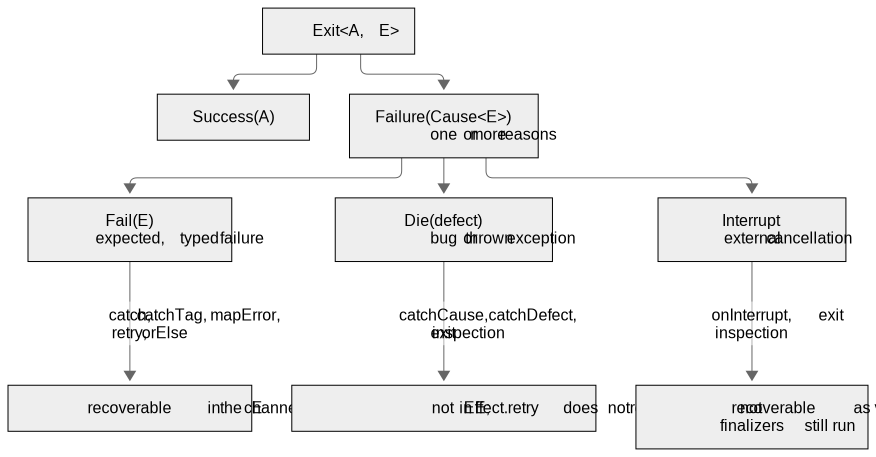
A failed Exit carries a Cause with one or more reasons. Only Fail(E) is in the typed error channel; defects and interruptions travel in the Cause, and Effect.retry does not retry a Cause that contains a defect.
Designing the error model
Decide what each unpleasant outcome is before writing a class for it. The channel it lands in determines who can see it, who may recover from it, and what retry and alerting code will do with it.
| Outcome | Belongs in | Ask | Example |
|---|---|---|---|
| A correct negative answer that every caller treats as ordinary output | the success value A (a tagged Data/Schema value, an Option, or a Result) | "Would every caller branch on this identically as part of normal operation?" | an eligibility check answers Ineligible { reason }; a band lookup answers Option.none() |
| A condition a valid caller can act on: recover, retry, translate, or compensate | a typed failure in E | "Does some caller need its own policy for this?" | EmployeeNotFound, BandViolation, HrisUnavailable |
| A broken invariant or a bug | a defect (Effect.die, Effect.orDie, a throw inside Effect.sync) | "Could any caller do something sensible with it?" — no | a stored salary is negative although the schema forbids it |
| The caller went away | interruption | never modeled by hand | timeout, race loser, shutdown |
Not everything unpleasant is a failure. If a service's job is to decide eligibility, "not eligible" is the product's answer, so the workflow succeeds with that classification and E stays reserved for outcomes callers must handle differently (invalid input, storage failure). Putting a correct negative answer in E makes retry schedules and alerts treat a right answer as a fault. Classifying at the layer that owns the question is also what legitimately produces E = never further up.
Fill in one row per failure before writing error classes. The columns are the decisions the classes must support:
| Failure | Detected by | What the caller can do | Channel | Retryable | Translated by | Logged by |
|---|---|---|---|---|---|---|
| no row for the employee id | repository (the query succeeded with zero rows) | answer 404, or skip the employee | E: EmployeeNotFound | no | repository, into a domain error | HTTP edge, at info level |
| proposed salary above the band | domain validation | request an exception, or reject | E: BandViolation | no | nobody; it is already domain language | nobody; it is expected |
| HRIS answers 503 or times out | HRIS adapter | retry with backoff, then degrade | E: HrisUnavailable { retryable } | yes, bounded | adapter wraps the driver error once | retry boundary (attempts), owner (terminal outcome) |
| a decoded row violates a guaranteed constraint | repository decode | nothing | defect | no | nobody | process edge through ErrorReporter |
| the request was aborted | runtime | nothing | interruption | never | never | not logged as a fault |
Rules that fall out of the worksheet:
- Model caller decisions, not the library's exception classes. One variant per distinct policy; fields carry the facts the policy needs (
retryable,employeeId,bandMax), never a message to parse. - Keep missing, conflict, unavailable, timeout, corrupt, forbidden, and unknown-infrastructure distinct whenever their policies differ, because collapsing them forces every caller to guess.
- Only a query that succeeded and returned nothing is "not found". Timeouts, permission errors, pool exhaustion, malformed rows, and unknown driver errors must never become
EmployeeNotFoundor a 404, and a constraint violation is a specific conflict only after checking which constraint fired. - Translate where knowledge is added: foreign throwable → one stable adapter error (wrap the unknown once, at the adapter) → domain meaning → sanitized public representation. A layer that adds no knowledge passes the error through unrenamed. Cancellable adapters shows the adapter end of that chain, including dying on rejections the contract does not allow.
- Interruption is cancellation. It is never a domain error, never a retry trigger, and not a fault to log by default.
- Public error values are an output surface. A
Schema.TaggedErrordeclared on an HTTP endpoint or RPC encodes every field, socause: Schema.Defect()publishes the wrapped error'snameandmessage(stacks are omitted unlessincludeStack: true). Keep diagnostic causes on internal errors; give public errors stable tags plus safe identifiers, and never serialize aCause, SQL text, a credential, or aRedacted.
The failure deep dive follows one operation through these decisions, including retry, timeout, and fallback.
Effect error handling
The catch* family handles failures while keeping recovery visible in the effect's type.
| Combinator | What it does |
|---|---|
Effect.catch | Recover from any expected error E. |
Effect.catchTag / catchTags | Recover from one (or several) tagged error variants by _tag — the workhorse. catchTag also accepts a non-empty array of tags. |
Effect.catchIf / Effect.catchFilter | Recover when a predicate or refinement over E holds, or when a Filter matches (and narrows). |
Effect.catchReason / catchReasons / unwrapReason | Recover at the level of a nested tagged reason field; see Core Runtime: error handling. An unmatched reason with no fallback re-fails with the original Cause. |
Effect.catchCause / catchDefect | Reach below typed errors to the full Cause, or specifically to unexpected defects. |
Effect.mapError / mapBoth / flip | Rewrite E without recovering, rewrite both channels, or swap A and E. |
Effect.filterOrFail / filterOrElse | Turn an unacceptable success into a typed failure, or into another Effect. |
Effect.match / matchEffect | Fold typed failure and success into one value; E becomes never (pure handlers) or the handlers' errors. |
Effect.matchCause / matchCauseEffect | The same fold, but onFailure receives the whole Cause, including defects and interruption. |
Effect.result / Effect.option / Effect.exit | Reify the outcome into a Result, an Option (the error value is discarded), or an Exit (the full Cause). |
Effect.validate / Effect.partition | Run every element and accumulate all failures instead of stopping at the first. |
Effect.tapError / tapErrorTag / tapCause / tapDefect | Observe failures (log them) without handling them; the original failure is re-raised when the observer succeeds. |
Effect.orElseSucceed / Effect.firstSuccessOf | Replace every typed failure with a plain value computed from the error, or try alternatives in order. |
Effect.ignore / Effect.ignoreCause | Discard the success value and typed failures (ignore), or additionally defects and interruption (ignoreCause). |
Effect.sandbox | Move the whole Cause<E> into the error channel so ordinary catch sees every reason. |
Effect.orDie | Convert the typed failure into a defect and remove it from E. |
Effect.fail / Effect.failSync / Effect.die | Create a typed failure (eagerly, or lazily so the error is built only on the failing path) or a defect. |
Name each handler's intent. Every catch* should be exactly one of four things: recover (supply a truthful value for the handled condition, not merely a way to empty E), translate (add meaning at an abstraction boundary with mapError), compensate (undo prior work, then re-fail), or observe (tap*, failure unchanged). A handler that does none of these is hiding a failure.
Define caught errors as schema-backed tagged classes — typed constructor, _tag for matching, and free serialization:
Self-contained source · Type-checked
import { Effect, Schema } from "effect"

class EmployeeNotFound extends Schema.TaggedError<EmployeeNotFound>()("EmployeeNotFound", {
  employeeId: Schema.String
}) {}

class BandViolation extends Schema.TaggedError<BandViolation>()("BandViolation", {
  employeeId: Schema.String,
  proposedSalary: Schema.Finite,
  bandMax: Schema.Finite
}) {}

const lookupEmployee = Effect.fn("lookupEmployee")(function*(id: string) {
  if (id === "") return yield* new EmployeeNotFound({ employeeId: id })
  if (id === "over-band") {
    return yield* new BandViolation({ employeeId: id, proposedSalary: 160_000, bandMax: 150_000 })
  }
  return { id, name: "Priya Sharma", level: "L4", baseSalary: 120_000 }
})

const safeComp = lookupEmployee("").pipe(
  // Handle each tagged error by name; TypeScript narrows `e` per tag.
  Effect.catchTags({
    EmployeeNotFound: (e) => Effect.succeed({ id: e.employeeId, name: "unknown", level: "L1", baseSalary: 0 }),
    BandViolation: (e) => Effect.logWarning(`salary ${e.proposedSalary} exceeds band max ${e.bandMax}`).pipe(
      Effect.as({ id: e.employeeId, name: "?", level: "L1", baseSalary: e.bandMax })
    )
  })
)
Selective recovery beyond one tag
Fragment · Type-checked
import { Effect, Filter, Schema } from "effect"

class EmployeeNotFound extends Schema.TaggedError<EmployeeNotFound>()("EmployeeNotFound", {
  employeeId: Schema.String
}) {}

class BandViolation extends Schema.TaggedError<BandViolation>()("BandViolation", {
  employeeId: Schema.String
}) {}

class HrisUnavailable extends Schema.TaggedError<HrisUnavailable>()("HrisUnavailable", {
  status: Schema.Int
}) {}

declare const proposeRaise: Effect.Effect<string, EmployeeNotFound | BandViolation | HrisUnavailable>

// One handler for several tags: E shrinks to HrisUnavailable.
const skipped = proposeRaise.pipe(
  Effect.catchTag(["EmployeeNotFound", "BandViolation"], (error) =>
    Effect.succeed(`skipped ${error.employeeId}: ${error._tag}`)
  )
)

// A Filter selects, and narrows, the failure to recover.
const cached = proposeRaise.pipe(
  Effect.catchFilter(Filter.tagged("HrisUnavailable"), (error) =>
    Effect.succeed(`served from cache after HTTP ${error.status}`)
  )
)

// A predicate over E: for a field test, or for errors that are not tagged classes.
const restarting = proposeRaise.pipe(
  Effect.catchIf(
    (error) => error._tag === "HrisUnavailable" && error.status === 503,
    () => Effect.succeed("HRIS is restarting; try again shortly")
  )
)catchTag, catchIf, catchFilter, and catchReason take an optional trailing orElse handler for the failures that did not match, which empties E in one call. Prefer the narrowest selector that expresses the policy, because the remaining union in E is the record of what has not been decided yet. Compiling proves little here, since a broad Effect.catch compiles as well; to show that exactly the intended tag was removed, pin the post-recovery type with an annotation (const skipped: Effect.Effect<string, HrisUnavailable> = ...) next to the behavior test.
Transforming the error channel
Fragment · Type-checked
import { Effect, FileSystem, Schema } from "effect"

// An internal error: the diagnostic cause never leaves the process.
class CompBandsUnavailable extends Schema.TaggedError<CompBandsUnavailable>()("CompBandsUnavailable", {
  path: Schema.String,
  cause: Schema.Defect()
}) {}

class NoManagerOnRecord extends Schema.TaggedError<NoManagerOnRecord>()("NoManagerOnRecord", {
  employeeId: Schema.String
}) {}

// mapError: translate a platform failure into the error this module owns. Nothing is recovered.
const loadBands = Effect.fn("loadBands")(function*(path: string) {
  const fs = yield* FileSystem.FileSystem
  return yield* fs.readFileString(path).pipe(
    Effect.mapError((cause) => new CompBandsUnavailable({ path, cause }))
  )
})

declare const findManagerId: (employeeId: string) => Effect.Effect<string | null>

// filterOrFail: an unacceptable success becomes a typed failure; a refinement narrows A.
const requireManager = (employeeId: string) =>
  findManagerId(employeeId).pipe(
    Effect.filterOrFail(
      (managerId): managerId is string => managerId !== null,
      () => new NoManagerOnRecord({ employeeId })
    )
) // Effect<string, NoManagerOnRecord>Effect.mapError(f)rewrites onlyE; use it at the layer that owns a dependency so driver and SDK errors do not leak upward.Effect.mapBoth({ onFailure, onSuccess })rewrites both channels in one pass.Effect.filterOrFail(predicate, orFailWith?)replacesflatMap+if+Effect.fail. WithoutorFailWithit fails withCause.NoSuchElementError.Effect.filterOrElseruns a fallback Effect instead of producing an error.Effect.flipswapsAandE. Its main use is a test that wants the typed error as a value (const error = yield* Effect.flip(effect)); in production codemapErroror a catch states the intent better.- Map before you
orDie. When a boundary deliberately promotes a failure to a defect,Effect.mapErrorfirst so the defect carries a meaningful error rather than a raw driver object.
Folding both channels at a boundary
Selective recovery keeps a workflow alive and leaves the rest of E for the next owner. Folding is the terminal move for an edge that must produce exactly one ordinary shape: an HTTP response, a CLI exit summary, a worker acknowledgement, a test observation.
Fragment · Type-checked
import { Effect, Schema } from "effect"

class EmployeeNotFound extends Schema.TaggedError<EmployeeNotFound>()("EmployeeNotFound", {
  employeeId: Schema.String
}) {}

class BandViolation extends Schema.TaggedError<BandViolation>()("BandViolation", {
  bandMax: Schema.Finite
}) {}

declare const proposeRaise: (employeeId: string) => Effect.Effect<number, EmployeeNotFound | BandViolation>

// Pure handlers. E is `never`: this boundary has accounted for every expected failure.
const response = proposeRaise("e-42").pipe(
  Effect.match({
    onFailure: (error) =>
      error._tag === "EmployeeNotFound"
        ? { status: 404 as const, body: { employeeId: error.employeeId } }
        : { status: 422 as const, body: { bandMax: error.bandMax } },
    onSuccess: (newSalary) => ({ status: 200 as const, body: { newSalary } })
  })
)

// Effectful handlers may log, record a metric, or fail with a new error.
const audited = proposeRaise("e-42").pipe(
  Effect.matchEffect({
    onFailure: (error) => Effect.logWarning("raise rejected", { tag: error._tag }).pipe(Effect.as(false)),
    onSuccess: (newSalary) => Effect.logInfo("raise approved", { newSalary }).pipe(Effect.as(true))
  })
)- Fold only at a terminal boundary. A lower layer that folds steals policy from its callers.
matchandmatchEffectsee typed failures only; a defect or interruption still fails the fiber.matchCauseandmatchCauseEffecthandonFailurethe wholeCause, so they are process- or request-edge tools with the same caution ascatchCause.- To make the fold exhaustive over a large union, delegate to a matcher from Classifying an error union.
Accumulating errors instead of failing fast
Effect.all and Effect.forEach stop at the first typed failure, which is wrong for form or batch validation where the caller needs every problem at once.
Fragment · Type-checked
import { Effect, Schema } from "effect"

class BandViolation extends Schema.TaggedError<BandViolation>()("BandViolation", {
  employeeId: Schema.String
}) {}

declare const checkRaise: (employeeId: string) => Effect.Effect<number, BandViolation>
const employeeIds = ["e-1", "e-2", "e-3"]

// Runs every check. Succeeds with Array<number>, or fails with NonEmptyArray<BandViolation>.
const allOrEveryViolation = Effect.validate(employeeIds, checkRaise, { concurrency: 4 })

// Runs every check and never fails: [approvedAmounts, violations].
const split = Effect.partition(employeeIds, checkRaise, { concurrency: 4 })

// One Result per member, in the shape of the input.
const perMember = Effect.all(employeeIds.map(checkRaise), { mode: "result" })| Need | Use | Outcome |
|---|---|---|
| Stop the batch at the first problem | Effect.all / Effect.forEach (default) | fails with the first E; when sequential, later elements never start |
| Every problem at once, or else every value | Effect.validate(items, f, { concurrency?, discard? }) | Array<B>, or fails with NonEmptyArray<E> (successes are dropped) |
| Act on both sides | Effect.partition(items, f, { concurrency? }) | never fails: [passes: Array<B>, fails: Array<E>] |
| Per-member outcome in the input's shape | Effect.all(effects, { mode: "result" }) | a Result per member |
A defect in any element still fails the whole call. Accumulate as data rather than as several Fail reasons in one Cause, because typed handlers inspect only the first Fail reason (see below).
Fallback values and ignoring failures
Fragment · Type-checked
import { Effect } from "effect"

declare const fromHris: Effect.Effect<number, "HrisUnavailable">
declare const fromReplica: Effect.Effect<number, "ReplicaStale">
declare const fromSnapshot: Effect.Effect<number, "NoSnapshot">

// Sequential; the first success wins. If all fail, the error is the last one: "NoSnapshot".
const bandMidpoint = Effect.firstSuccessOf([fromHris, fromReplica, fromSnapshot])
Effect.orElseSucceed(() => value)replaces every typed failure. The function receives the error ((error) => ...), matchingStream.orElseSucceed, so the fallback can depend on it; a zero-argument function still works. If only "not found" should default, narrow withcatchTagfirst and keep the rest typed.Effect.firstSuccessOf(effects)tries different effects in order; an empty iterable is a defect. When the same effect should run under different provided services, useExecutionPlaninstead.Effect.optiondiscards the error value, so use it only when every typed failure of that effect genuinely means "absent"; otherwise useEffect.result. Both leave defects and interruption as fiber failures.Effect.ignorediscards typed failures only — a defect or interruption still fails the fiber.Effect.ignoreCausealso discards defects and interruption and can therefore hide bugs; reserve it for best-effort cleanup. Both accept{ log: true | severity | "Unhandled", message }to log theCausewhile ignoring it.log: "Unhandled"readsReferences.UnhandledLogLevelwhen the failure happens and logs nothing when that reference isundefined, so the application decides centrally how loudly swallowed failures are reported; the same option exists on theStreamandChannelvariants.
Recovery and mixed causes
A Cause is a flat list of reasons and may hold a typed failure and a defect or interruption at once: a failing operation whose finalizer dies, a concurrent sibling whose cleanup dies while being interrupted, or a race in which every contender fails.
A defect wins over a typed failure. When the runtime combines a typed failure with a defect — a finalizer that dies after the operation failed, or a sibling that dies — the typed failure is recorded as a defect too, so the cause reads [Die(error), Die(defect)]. And when a cause that still holds a Fail beside a Die reaches a typed recovery operator — catch, catchTag(s), catchIf, catchFilter, catchReason(s), orElseSucceed, firstSuccessOf, match, matchEffect, result, option, ignore, orDie, or retry — the operator does not recover: it converts every typed error to a defect, keeps the reason order and any interruptions, and propagates the cause. A crashing finalizer or dying sibling therefore cannot be swallowed by catchTag. Only catchCause, catchDefect, Effect.exit, and Effect.sandbox see such a cause as recoverable.
An interruption beside a typed failure does not block recovery. With reasons [Fail(e), Interrupt], the typed operators handle e and the handler's result becomes the whole outcome — the interruption is dropped, and retry retries. Typed recovery inspects only the first Fail reason, so catchTag("B") does not fire for [Fail(A), Fail(B)], and orDie keeps only Die(A). mapError is different from recovery: it maps every typed error in place and preserves defects, interruptions, and reason order. tapError and tapCause re-raise the original Cause, so they lose nothing.
Self-contained source · Type-checked
import { Cause, Effect, Schema } from "effect"

class ExportFailed extends Schema.TaggedError<ExportFailed>()("ExportFailed", {
  batchId: Schema.String
}) {}

// A typed failure whose finalizer then dies: reasons [Die(ExportFailed), Die(Error)].
const exportBatch = Effect.fail(new ExportFailed({ batchId: "b-7" })).pipe(
  Effect.ensuring(Effect.die(new Error("ledger handle already closed")))
)

// Does not recover: the defect takes precedence, so the handler never runs.
const stillDies = exportBatch.pipe(
  Effect.catchTag("ExportFailed", () => Effect.succeed("skipped"))
)

// Recover deliberately only through the full Cause, and only for what you own.
const careful = exportBatch.pipe(
  Effect.catchCause((cause) =>
    Cause.hasDies(cause) || Cause.hasInterrupts(cause)
      ? Effect.failCause(cause)
      : Effect.succeed("skipped")
  )
)
Migration: In earlier 4.0 releases a typed handler on a
[Fail, Die]cause succeeded and dropped the defect. Code that relied oncatchTagto absorb a failure whose cleanup also crashed now sees the crash; handle it withcatchDefector a guardedcatchCausewhere that is genuinely intended.
The failure deep dive covers reason inspection and the Effect.sandbox route: Inspect the full Cause without flattening it.
Official guides: Error Channel Operations, Matching, Error Accumulation, Fallback.
Classifying an error union
Before choosing a catch operator, write down which boundary owns each variant: validation failures belong to the API edge, transient transport failures to the retry boundary, impossible invariants to defects rather than E. When one boundary must classify the whole union — a status code, a retry decision, a user message — finish the matcher with Match.exhaustive or Match.tagsExhaustive, never a switch with default, so that adding a variant fails compilation exactly where policy must be updated. A default branch silently assigns tomorrow's error to today's fallback.
Fragment · Type-checked
import { Effect, Match, Schema } from "effect"

class InvalidRaise extends Schema.TaggedError<InvalidRaise>()("InvalidRaise", {
  requestedPercent: Schema.Finite
}) {}

class EmployeeNotFound extends Schema.TaggedError<EmployeeNotFound>()("EmployeeNotFound", {
  employeeId: Schema.String
}) {}

class HrisUnavailable extends Schema.TaggedError<HrisUnavailable>()("HrisUnavailable", {
  status: Schema.Int
}) {}

type RaiseFailure = InvalidRaise | EmployeeNotFound | HrisUnavailable
type Policy = "reject-input" | "report-missing" | "retry-later" | "page-oncall"

// Field-sensitive policy. Adding a variant to RaiseFailure breaks compilation here.
const policyFor = Match.type<RaiseFailure>().pipe(
  Match.tag("InvalidRaise", (): Policy => "reject-input"),
  Match.tag("EmployeeNotFound", (): Policy => "report-missing"),
  Match.tag("HrisUnavailable", ({ status }): Policy => (status >= 500 ? "retry-later" : "page-oncall")),
  Match.exhaustive
)

// Table form: one handler per tag, checked for completeness.
const statusFor = Match.type<RaiseFailure>().pipe(
  Match.tagsExhaustive({
    InvalidRaise: () => 422,
    EmployeeNotFound: () => 404,
    HrisUnavailable: () => 503
  })
)

// Plain data works too: `satisfies` rejects a missing or misspelled tag.
const retryable = {
  InvalidRaise: false,
  EmployeeNotFound: false,
  HrisUnavailable: true
} as const satisfies Record<RaiseFailure["_tag"], boolean>

declare const approveRaise: Effect.Effect<number, RaiseFailure>

// The terminal fold delegates to the exhaustive classifiers.
const response = approveRaise.pipe(
  Effect.match({
    onFailure: (error) => ({ status: statusFor(error), policy: policyFor(error) }),
    onSuccess: (newSalary) => ({ status: 200, newSalary })
  })
)- Reserve
Match.orElsefor a deliberate fallback, and say in a comment why new variants may land there. Match.fn((...args) => selected)builds a classifier that takes extra arguments (a locale, a request id):Match.taghandlers receive the narrowed value followed by the original arguments. Finish it withMatch.exhaustive;Match.tagsExhaustiveis typed for matchers without extra arguments.- A
Schema.TaggedUnioncarries its own exhaustive.match(value, cases);.matchOrElse(value, cases, orElse)is the partial form with a typed fallback (see Schema unions).Data.taggedEnumprovides$match(below). - Completeness is mechanical. The compiler proves every tag has a row; it cannot prove a row is right. That needs domain review and a test per policy.
The full Match API lives in The Functional Toolkit.
Option
effect/Option — stable
Option.some(a) or Option.none(). The typed replacement for null/undefined — absence is in the type, not an implicit convention.
Mental model. A list with zero or one element. map, flatMap, filter are no-ops on none, enabling chainable transforms without null checks.
Self-contained source · Type-checked
import { Option } from "effect"

// An employee record may or may not have a manager (top-level employees don't).
interface Employee {
  id: string
  name: string
  managerId: string | null | undefined
}

const employee: Employee = { id: "e-42", name: "Priya Sharma", managerId: null }

// Turn a nullable field into an Option, then transform safely.
const managerDisplay = Option.fromNullishOr(employee.managerId).pipe(
  Option.map((mid) => `reports to ${mid}`),
  Option.getOrElse(() => "no direct manager (top-level)")
)
// managerDisplay: "no direct manager (top-level)"

// Pattern-match both branches exhaustively.
const describeManager = (opt: Option.Option<string>) =>
  Option.match(opt, {
    onNone: () => "IC or department head — no manager on record",
    onSome: (mid) => `manager employee id: ${mid}`
  })
Use when a value is legitimately optional and the compiler must enforce handling of absence — optional config lookups, "find first" results, optional fields.
Combining optional values
Fragment · Type-checked
import { Option } from "effect"

interface CompBand {
  readonly level: string
  readonly max: number
}

declare const findLevel: (employeeId: string) => Option.Option<string>
declare const findBand: (level: string) => Option.Option<CompBand>
declare const currentSalary: Option.Option<number>

// flatMap: a dependent lookup that is itself optional, without nesting Options.
const band = findLevel("e-42").pipe(Option.flatMap(findBand))

// filter: keep the value only when the predicate holds.
const roomyBand = band.pipe(Option.filter((b) => b.max > 120_000))

// all: independent Options in a struct or tuple; any None collapses the whole result.
const inputs = Option.all({ band, salary: currentSalary })

// zipWith: exactly two values.
const headroom = Option.zipWith(band, currentSalary, (b, salary) => b.max - salary)

// gen: imperative style that stops at the first None.
const headroomPercent = Option.gen(function*() {
  const b = yield* band
  const salary = yield* currentSalary
  return ((b.max - salary) / salary) * 100
})
Option.gen evaluates eagerly, so keep its body pure; reach for Effect.gen plus Effect.fromOption when a step has side effects.
Option.partitionMap(self, f) applies a Result-returning function and splits the outcome: [passes: Option<C>, fails: Option<B>], successes before failures — the same successes-first convention as Effect.partition above.
Fallbacks and boundary exits
Fragment · Type-checked
import { Option } from "effect"

declare const employeeOverride: Option.Option<string>
declare const teamDefault: Option.Option<string>

// The first present value wins: override, then team default, then the global default.
const bandId = Option.firstSomeOf([employeeOverride, teamDefault, Option.some("L1")])

// orElse takes a lazy alternative Option.
const overrideOrTeam = employeeOverride.pipe(Option.orElse(() => teamDefault))

// liftPredicate: a boolean test becomes an Option-returning function.
const positiveRaise = Option.liftPredicate((percent: number) => percent > 0)
positiveRaise(-5) // Option.none()
positiveRaise(4) // Option.some(4)| Exit | Use it at |
|---|---|
Option.getOrElse(() => fallback) | rendering and defaults that the boundary owns |
Option.getOrNull / Option.getOrUndefined | JSON, SQL parameters, UI props — the mirror of fromNullOr / fromUndefinedOr / fromNullishOr |
Option.match({ onNone, onSome }) | both branches produce a value |
Option.getOrThrow / Option.getOrThrowWith(() => error) | invariants only; it reintroduces the hidden crash the type removed |
Keep absence visible until a real boundary. Carry an optional domain field as Option through the domain and collapse it only where rendering, JSON, SQL, or interop needs a concrete value. Use None when callers need no reason and Result when they must act on one. The quiet wrong turn is defaulting every branch to a plausible success (getOrElse(() => 0) for an unknown salary): it type-checks and is silently wrong.
Option.makeEquivalence and Option.makeOrder lift an Equivalence or Order for A to Option<A>, so optional fields can take part in sorting and de-duplication. None orders before every Some; Order.flip reverses the whole order, which puts missing values last and present values in descending order.
Official guides: Option (its statement that an Option can be yielded directly inside Effect.gen does not hold for this edition's tagged source; see Moving between Option, Result, and Effect), Effect Data Types (Schema) for nullable and optional wire shapes that decode to Option.
Result
effect/Result — stable
Result.succeed(a) or Result.fail(e). Synchronous, pure success-or-failure — Effect's error channel without async or requirements.
Mental model. Effect minus the runtime. Use Result for pure computations that can fail (validation, parsing); bridge into Effect with Effect.result to materialize an outcome.
Self-contained source · Type-checked
import { Effect, Result } from "effect"

interface CompBand { min: number; mid: number; max: number }

// A pure validation — is a raise recommendation within the comp band?
const validateRaise = (
  currentSalary: number,
  proposedSalary: number,
  band: CompBand
): Result.Result<number, string> => {
  if (proposedSalary < band.min)
    return Result.fail(`proposed salary ${proposedSalary} is below band minimum ${band.min}`)
  if (proposedSalary > band.max)
    return Result.fail(`proposed salary ${proposedSalary} exceeds band maximum ${band.max}`)
  if (proposedSalary <= currentSalary)
    return Result.fail(`raise must exceed current salary ${currentSalary}`)
  return Result.succeed(proposedSalary)
}

const band: CompBand = { min: 100_000, mid: 125_000, max: 150_000 }
const approved = Result.getOrElse(validateRaise(120_000, 130_000, band), () => 120_000) // 130_000
const rejected = Result.getOrElse(validateRaise(120_000, 160_000, band), () => 120_000) // 120_000 (capped)

// Bridge the Effect error channel INTO a Result to inspect it without failing.
const program = Effect.gen(function*() {
  const outcome = yield* Effect.result(Effect.fail("HrisUnavailable"))
  if (Result.isFailure(outcome)) {
    yield* Effect.log(`comp lookup failed: ${outcome.failure}`)
  }
})
Use when you need a pure, eager "did it work?" value — validation logic, eligibility checks, or inspecting an effect's outcome before branching.
Transforming and combining Results
Fragment · Type-checked
import { Result } from "effect"

declare const salary: Result.Result<number, string>
declare const levelMidpoint: Result.Result<number, string>

// all: struct (or tuple) in, same shape out. The FIRST failure wins; nothing is accumulated.
const compaRatio = Result.all({ salary, levelMidpoint }).pipe(
  Result.map(({ salary, levelMidpoint }) => salary / levelMidpoint),
  Result.flatMap((ratio) => ratio > 1.2 ? Result.fail("above the band ceiling") : Result.succeed(ratio)),
  Result.mapError((reason) => ({ _tag: "InvalidComp" as const, reason }))
)

// match folds both branches into one value.
const label = Result.match(compaRatio, {
  onFailure: (error) => `rejected: ${error.reason}`,
  onSuccess: (ratio) => `compa-ratio ${ratio.toFixed(2)}`
})
Result.map / mapError / mapBoth transform one or both sides, flatMap chains a dependent check, and Result.gen is the imperative form. Result.all and Result.gen stop at the first failure; to collect every problem, validate each field to a Result and gather the failures yourself, or use Effect.validate. Like Option.gen, Result.gen runs eagerly and should stay free of side effects.
Moving between Option, Result, and Effect
Climb only when the semantics change: absence → absence with a reason → a reason inside a workflow.
| From → to | Function | Notes |
|---|---|---|
nullable → Option | Option.fromNullishOr (fromNullOr, fromUndefinedOr) | |
Option → Result | Result.fromOption(option, () => reason) | upgrades absence into a named failure |
Result → Option | Result.getSuccess / Result.getFailure | deliberately discards the other side |
Option → Effect | Effect.fromOption(option, () => error) | without the second argument, None fails with Cause.NoSuchElementError |
Result → Effect | Effect.fromResult(result) | a Failure<E> becomes the typed failure E |
nullable → Effect | Effect.fromNullishOr(value) | fails with Cause.NoSuchElementError |
Effect → Result / Option / Exit | Effect.result / Effect.option / Effect.exit | result and option capture typed failures only; exit captures the full Cause |
Fragment · Type-checked
import { Data, Effect, Option, Result } from "effect"

interface Employee {
  readonly id: string
  readonly managerId: string | null
}
declare const employees: ReadonlyArray<Employee>

class NoSuchEmployee extends Data.TaggedError("NoSuchEmployee")<{ readonly employeeId: string }> {}
class NoManager extends Data.TaggedError("NoManager")<{ readonly employeeId: string }> {}

// Absence: callers need no reason.
const findEmployee = (employeeId: string) =>
  Option.fromNullishOr(employees.find((employee) => employee.id === employeeId))

// Absence plus a reason: still pure, now a named failure.
const requireEmployee = (employeeId: string) =>
  Result.fromOption(findEmployee(employeeId), () => new NoSuchEmployee({ employeeId }))

// A reason inside a workflow: convert explicitly, then yield the Effect.
const loadManagerId = Effect.fn("loadManagerId")(function*(employeeId: string) {
  const employee = yield* Effect.fromResult(requireEmployee(employeeId))
  return yield* Effect.fromOption(
    Option.fromNullishOr(employee.managerId),
    () => new NoManager({ employeeId })
  )
}) // Effect<string, NoSuchEmployee | NoManager>
Warning:
OptionandResultare not yieldable insideEffect.gen, and neither is a subtype ofEffect.yield* someOptionis rejected by TypeScript at theEffect.gencall, and if the types are bypassed the fiber dies withFiber.runLoop: Not a valid effect: some(1). Convert withEffect.fromOption/Effect.fromResult(also before passing one toEffect.all), or match on it.Option.genandResult.gendo yield their own type. The official Option and Result guides, and upstreammigration/yieldable.md, say otherwise; the tagged source wins.
Pulling a value out early with Option.getOrThrow, or re-throwing result.failure, reintroduces exactly the hidden branch these types removed. For the three-way choice itself, see Option vs Result vs Effect.
Official guide: Result (the same caveat applies to its claim that a Result can be yielded inside Effect.gen).
Filter
effect/Filter — stable
A function (input) => Result<Pass, Fail> that decides whether a value passes (optionally refining or transforming it) or is filtered out. A predicate that can narrow the type and explain the rejection.
Mental model. A refinement built on Result. The pass branch can have a different type than the input, so filters act as type guards and mini-parsers that compose. They power Effect.catchFilter and stream filtering.
Self-contained source · Type-checked
import { Filter, Result } from "effect"

interface Employee { id: string; name: string; level: string; performanceRating: string; baseSalary: number }

// A filter that keeps only employees eligible for a merit increase:
// must be rated "exceeds" or "meets" and not already at band maximum.
const BAND_MAX = 150_000

const eligibleForMerit = Filter.make((emp: Employee) => {
  if (emp.performanceRating === "below")
    return Result.fail(emp) // filtered out — not eligible
  if (emp.baseSalary >= BAND_MAX)
    return Result.fail(emp) // filtered out — already at ceiling
  return Result.succeed(emp) // passes through for raise calculation
})

const priya: Employee = { id: "e-42", name: "Priya Sharma", level: "L4", performanceRating: "exceeds", baseSalary: 120_000 }
eligibleForMerit(priya)  // Result.succeed(priya)

const atCeiling: Employee = { id: "e-99", name: "Dev Anand", level: "L5", performanceRating: "meets", baseSalary: 150_000 }
eligibleForMerit(atCeiling)  // Result.fail(atCeiling) — at band max

// Built-in filters compose; turn one into a plain predicate when needed.
const isNumber = Filter.toPredicate(Filter.number)
isNumber(42) // true
Filter.tagged("Tag") is the ready-made filter for one member of a _tag union; pass it to Effect.catchFilter as shown in Selective recovery beyond one tag.
Use when you need a reusable, composable keep-or-drop rule that also refines types — selective error recovery with catchFilter, or validating-and-narrowing untrusted input.
Data
effect/Data — stable
Helpers for defining value types — classes, tagged classes, tagged enums (discriminated unions), and error classes. Two Data values with the same contents are Equal, usable as keys in HashMap/HashSet and comparable via Equal.equals.
Mental model. Equal.equals is already structural for plain objects, arrays, and instances of ordinary classes, so Data is not what gives you value equality. Data supplies the ergonomics around it: class syntax with a typed constructor argument, an automatic _tag, tagged-enum constructors with $is/$match, and yieldable Error subclasses. A plain factory function is a complete value-object constructor when you need none of that; Equal.byReference(value) opts one object back into reference equality.
Self-contained source · Type-checked
import { Data, Equal } from "effect"

// A tagged union for the state of a raise recommendation in a merit workflow.
type RaiseState = Data.TaggedEnum<{
  Pending: { readonly employeeId: string }
  Approved: { readonly employeeId: string; readonly newSalary: number }
  Rejected: { readonly employeeId: string; readonly reason: string }
}>
const { Pending, Approved, Rejected, $match } = Data.taggedEnum<RaiseState>()

const a = Approved({ employeeId: "e-42", newSalary: 130_000 })
const b = Approved({ employeeId: "e-42", newSalary: 130_000 })
Equal.equals(a, b) // true — structural, not reference

const describe = $match({
  Pending: (s) => `awaiting approval for ${s.employeeId}`,
  Approved: (s) => `${s.employeeId} approved at $${s.newSalary}`,
  Rejected: (s) => `${s.employeeId} rejected: ${s.reason}`
})
describe(a) // "e-42 approved at $130000"
$is(tag) is the reusable type guard that pairs with $match, and Data.Class / Data.TaggedClass are the class forms — the ones that can carry getters and methods:
Self-contained source · Type-checked
import { Data, Equal } from "effect"

type RaiseState = Data.TaggedEnum<{
  Pending: { readonly employeeId: string }
  Approved: { readonly employeeId: string; readonly newSalary: number }
}>
const { $is, Approved, Pending } = Data.taggedEnum<RaiseState>()

const states = [Pending({ employeeId: "e-1" }), Approved({ employeeId: "e-42", newSalary: 130_000 })]
const approved = states.filter($is("Approved")) // narrowed: newSalary is typed

class CompBand extends Data.Class<{ readonly level: string; readonly min: number; readonly max: number }> {
  get midpoint() {
    return (this.min + this.max) / 2
  }
}

const l4 = new CompBand({ level: "L4", min: 100_000, max: 150_000 })
const same = new CompBand({ level: "L4", min: 100_000, max: 150_000 })
const sameReference = l4 === same // false: `===` is still reference equality
const sameValue = Equal.equals(l4, same) // true

// Update by replacement.
const widened = new CompBand({ level: l4.level, min: l4.min, max: 160_000 })
Three caveats:
readonlyis a TypeScript promise, not a runtime freeze.Datavalues are not frozen, so a cast can still mutate one.===remains reference equality. UseEqual.equalswherever value equality is meant: assertions, de-duplication, cache keys.- Never mutate a value after it has been compared, hashed, or used as a key.
Equal.equalscaches its result per object pair andHashcaches hashes, so a mutated value keeps its stale equality. Build a new value instead.
The Data module exports Class, TaggedClass, TaggedEnum / taggedEnum, Error, and TaggedError. Generic unions use Data.TaggedEnum.WithGenerics<N>.
Data.TaggedError builds an Error subclass that is also a tagged, value-equal effect failure — suitable for quick internal errors. For serializable errors, prefer Schema.TaggedError (shown above).
Self-contained source · Type-checked
import { Data } from "effect"

// Quick internal errors — no schema needed, but still tagged and value-equal.
class BudgetExceeded extends Data.TaggedError("BudgetExceeded")<{
  readonly requested: number
  readonly remaining: number
}> {}

class EmployeeNotFound extends Data.TaggedError("EmployeeNotFound")<{
  readonly employeeId: string
}> {}
Yieldable errors. Classes built with Data.Error, Data.TaggedError, Schema.Error, or Schema.TaggedError extend Cause.YieldableError, so yield* new BudgetExceeded({ ... }) inside Effect.gen is the same as yield* Effect.fail(new BudgetExceeded({ ... })); return yield* tells TypeScript the branch ends there. Data.Error is the untagged base: still an Error subclass with typed fields, but not selectable by catchTag.
Fragment · Type-checked
import { Data, Effect } from "effect"

class LedgerCorrupted extends Data.Error<{ readonly ledgerId: string }> {}

// A field literally named `cause` becomes the native `Error.cause`, so `Cause.pretty`
// and the Node inspector print the wrapped exception under `[cause]`.
class PayrollExportFailed extends Data.TaggedError("PayrollExportFailed")<{
  readonly batchId: string
  readonly cause: unknown
}> {}

declare const pushBatch: (batchId: string, signal: AbortSignal) => Promise<void>

const exportBatch = (batchId: string) =>
  Effect.tryPromise({
    try: (signal) => pushBatch(batchId, signal),
    catch: (cause) => new PayrollExportFailed({ batchId, cause })
  })

const verifyLedger = Effect.fn("verifyLedger")(function*(ledgerId: string, checksumOk: boolean) {
  if (!checksumOk) return yield* new LedgerCorrupted({ ledgerId })
  return ledgerId
})
Warning:
_tagstrings must be unique across every error that can meet in one union.catchTagand TypeScript narrowing both trust the tag, and nothing stops two classes from reusing one: they become indistinguishable, with no compiler or runtime warning. Namespace tags that cross package boundaries ("Payroll/ExportFailed").
Use when you need value objects, discriminated unions with tidy constructors and a built-in matcher, or lightweight tagged errors.
Official guides: Data, Yieldable Errors.
ErrorReporter
effect/ErrorReporter — unstable
A pluggable sink for reporting Causes — controls how unhandled failures are surfaced. Register reporters via a Context.Reference; annotate error types with severity and attributes for structured rendering.
Mental model. Logging is for messages; ErrorReporter is for errors as first-class artifacts — it understands Cause structure, severity, and per-error metadata.
Self-contained source · Type-checked
import { Cause, Effect, ErrorReporter } from "effect"

// Report a cause through the currently-installed reporters.
// Here: a comp service failed during a merit cycle run.
const program = ErrorReporter.report(
  Cause.fail("HrisUnavailable: timed out fetching employee roster")
)

// Mark a domain error's severity and structured attributes so reporters render it richly.
class BandViolationError extends Error {
  override readonly [ErrorReporter.severity] = "Error"
  override readonly [ErrorReporter.attributes] = { employeeId: "e-42", proposedSalary: 160_000, bandMax: 150_000 }
}
Use when you need centralized, structured error reporting (to a dashboard, Sentry-like sink, or custom channel) that understands causes and severity.
PlatformError
effect/PlatformError — unstable
The typed error family for platform operations (filesystem, paths, child processes). Two shapes: BadArgument (invalid input) and SystemError (OS-level failure: ENOENT, EACCES, etc.), unified under PlatformError.
Mental model. FileSystem.readFileString fails with a PlatformError you can catchTag on, including the syscall, path, and reason — not a stringly-typed Error.
Self-contained source · Type-checked
import { Effect, FileSystem } from "effect"

// Load a comp-band configuration file. Recover gracefully if the file is missing.
const loadCompBands = Effect.fn("loadCompBands")(
  function*() {
    const fs = yield* FileSystem.FileSystem
    return yield* fs.readFileString("./comp-bands.json")
  },
  // PlatformError is tagged ("PlatformError"); its .reason holds BadArgument | SystemError.
  Effect.catchTag("PlatformError", (error) =>
    error.reason._tag === "NotFound"
      ? Effect.logWarning("comp-bands file not found").pipe(
          Effect.as("{}") // fall back only for the expected missing-file case
        )
      : Effect.fail(error) // preserve permission, timeout, invalid-input, and other failures
  )
)
Use when handling I/O from platform modules (FileSystem, Path, process) and reacting to specific failure reasons — e.g., distinguishing a missing file from a permission error.
The three failure buckets
Tip: Expected problems (not found, out of band, budget exceeded) belong in the typed
Echannel as tagged errors youcatchTag. Unexpected problems (bugs, "impossible" states) should be defects — surface them viaCause/ErrorReporterrather than modeling as recoverable errors.
| Bucket | How it arises | Where it shows up | Who may recover | What a test asserts |
|---|---|---|---|---|
| Typed failure | Effect.fail, yielding an error instance, Effect.try / tryPromise (the { try, catch } form fails with what catch returns; the direct function form fails with Cause.UnknownError), a failed decode | E, and a Fail reason in the Cause | the narrowest owner with a meaningful policy (catchTag, Effect.match) | the tag and the fields, through Exit.findErrorOption(exit) |
| Defect | Effect.die, Effect.orDie, a throw inside Effect.sync, a rejection inside Effect.promise | not in E; a Die reason | a process or request boundary that reports it (ErrorReporter, tapDefect, catchDefect) | Exit.hasDies(exit), and that Exit.findErrorOption(exit) is None |
| Interruption | timeout, race loser, Fiber.interrupt, a closing scope, a host signal | not in E; an Interrupt reason | nobody: finalizers run and it propagates | Exit.hasInterrupts(exit) plus the cleanup effect, never a domain tag |
Exit.findErrorOption returns None for defects and interruptions, so a typed-failure assertion cannot accept a defect by accident. Two gotchas: retrying or defaulting a defect hides a bug, and translating interruption into a user-facing error creates noise and can block shutdown. Where a boundary must survive a defect (a plugin host, a per-job worker), Effect.catchDefect should recover only the defect it recognizes and re-raise the rest with Effect.die(defect). The testing deep dive shows these assertions in context: Assert typed failures as data. For symptoms and fixes, see Typed failure versus defect and interruption.